foundyou.online - Directory for New Media Art
Open Filters

Originally conceived as a digital effects and coding atelier and center for youth education, Eyebeam has become a center for the research, development, and curation of new media works of art and open source technology. Eyebeam annually hosts up to 20 residents and co-produces youth educational programs, exhibitions, performances, symposia, workshops, hackathons and other events with these residents as well as with partner organizations. Projects developed at Eyebeam have received awards and recognition including Webby Awards, Guggenheim Fellowships, and the Prix Ars Electronica. [1]

Eyebeam provides both space and support for a community of diverse, impact-driven artists. The residency program brings artists’ work to life and into the world by providing access to advanced tools and resources and launching dynamic public events, assisted by an engaged community of alumni.[2]

superbad.comsuperbad.comsuperbad.comsuperbad.comsuperbad.com

Superbad is a noted web art installation created by Ben Benjamin in 1997.

It received a 1999 Webby in the "Weird" category, and was one of nine websites featured in the Whitney Museum Biennial in 2000. Superbad began as a test bed for Benjamin's web design for technology corporations ranging from E! Online to Nippon Telegraph and Telephone. It heavily samples Japanese popular culture. [1]

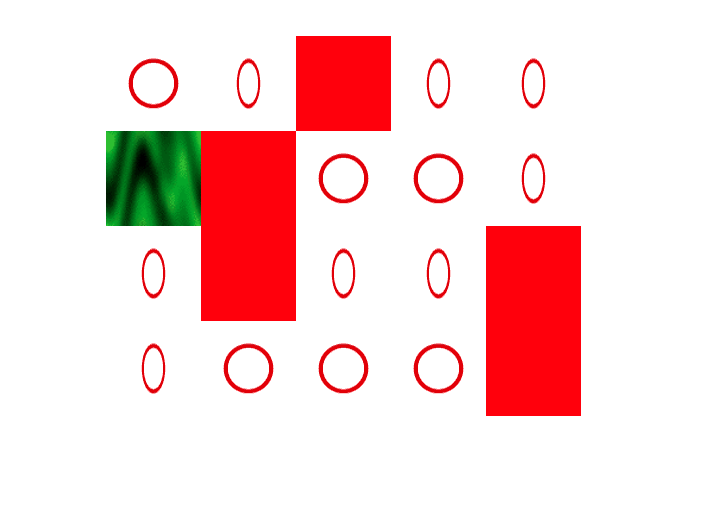
The site consists of a veritable maze of inter-linked visual, conceptual "subprojects" ranging from two-tone and technical-looking to wacky, colorful, and even bizarre. Often a subproject will have clickable elements linked to other pages within that subproject, or to another, or that just provide visual richness (for example, the "follow" subproject has a grid of circles with arrows that follow the mouse cursor; each circle is a link to a different page within the site). Some of the pages contain narrative elements. There are 143 different pages. His main page serves as a hub to all his subprojects. Clicking anywhere on the "bad" will link to somewhere within each subproject. [1]

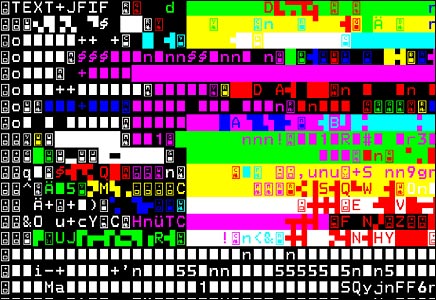
Internet provocateurs JODI pioneered Web art in the mid-1990s. Based in The Netherlands, JODI (Joan Heemskerk and Dirk Paesmans) were among the first artists to investigate and subvert conventions of the Internet, computer programs, and video and computer games. Radically disrupting the very language of these systems, including interfaces, commands, errors and code, JODI stages extreme digital interventions that destabilize the relationship between computer technology and its users. [1]

JODI (Joan Heemskerk and Dirk Paesmans) was formed in 1994. Joan Heemskerk was born in 1968 in Kaatsheue, The Netherlands. Dirk Paesmans was born in 1965 in Brussels, Belgium. Heemskerk and Paesman both attended Silicon Valley's electronic arts laboratory CADRE at San Jose State University in California; Paesmans also studied with Nam June Paik at the Kunstakademie in Dusseldorf. JODI's works are typically seen online. Their recent solo exhibitions include INSTALL.EXE at Eyebeam, New York, which toured to [plug-in], Basel, and BuroFriedrich, Berlin; and Computing 101B at FACT Centre, Liverpool, England. Their works have also been exhibited at Centre for Contemporary Art, Glasgow; Kunstverein Bonn; Stedelijk Museum, Amsterdam; Zentrum fur Kunst und Medientechnologie, Karlsruhe, Germany; Documenta X, Kassel, Germany; Harvard Art Museum, Massachusetts; EAI at ICA, Phillidelphia; and Lisson Gallery, New York, among many others. [1]

Misusing technological tools and languages has been a trademark for Jodi.org (Joan Heemskerk and Dirk Paesmans) since the mid-nineties, when they emerged as the pioneers of a movement which later became internationally known as net.art. Starting by applying this creative strategy to browsers, subverting websurfing logics and hacking the graphic interface, they then moved to videogames and finally to the so-called Web 2.0, deconstructing platforms such as Blogger, Google Maps and now Twitter. [2]

Selected net art pieces [3]

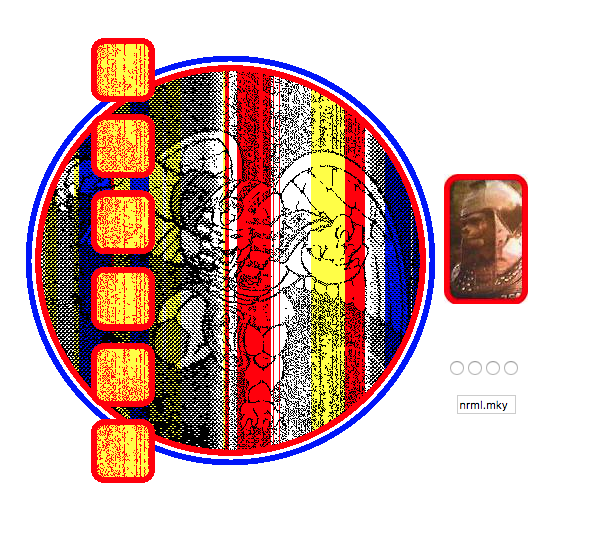
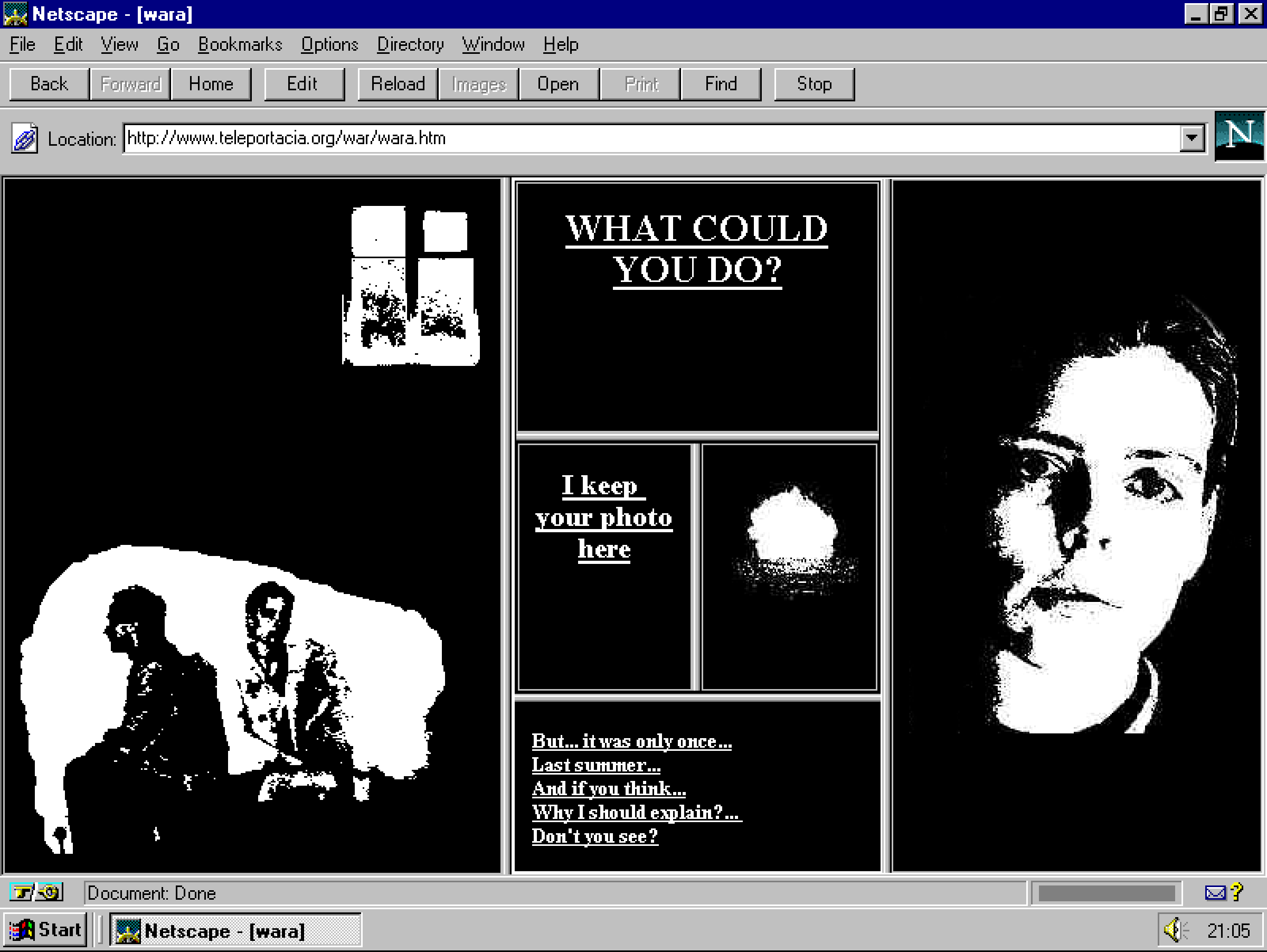
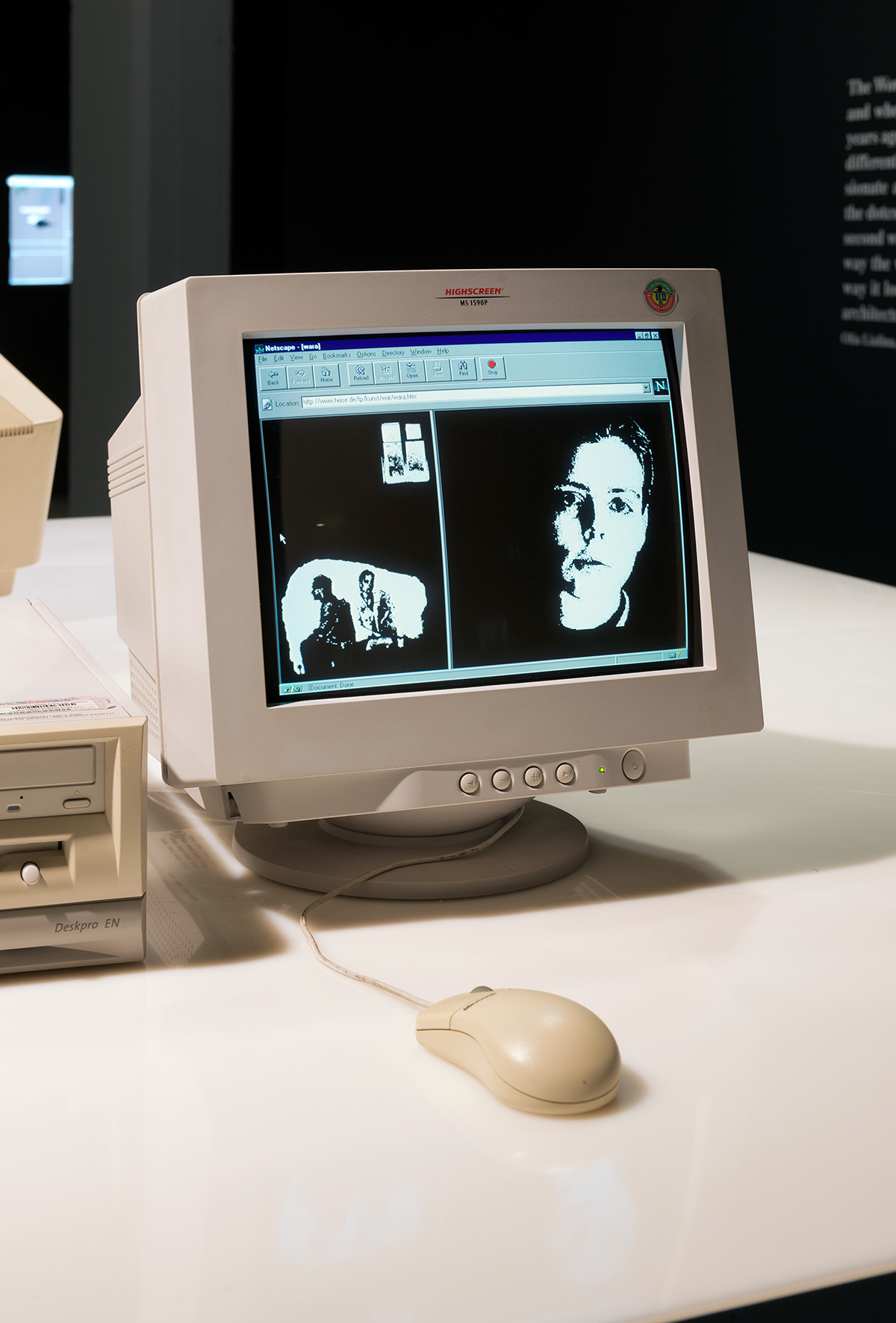
My Boyfriend Came Back From the War is an example of interactive hypertext storytelling. The work consists of nested frames with black and white web pages and (sometimes animated) grainy GIF images. When clicking hyperlinks in the work, the frame splits into smaller frames and the user reveals a nonlinear story about a couple that is reunited after a nameless military conflict. The lovers find it difficult to reconnect; the woman confesses that she has had an affair with a neighbour while the returned soldier proposes marriage. The story unfolds to the point where the screen has become a mosaic of empty black frames. [1]

Olia Lialina calls the work a netfilm, because of its similarity with cinematic narrative. The grainy black-and-white images and intertitles refer to early silent movies. Of its filmic qualities, curator Michael Connor wrote of the work, "the work adapts cinematic montage to the web ... separate frames are joined together by HTML code and the browser itself and experienced in both space and in time, employing what Lev Manovich has characterized as spatial and temporal montage." [1]
https://anthology.rhizome.org/my-boyfriend-came-back-from-the-war

Rhizome champions born-digital art and culture through commissions, exhibitions, digital preservation, and software development. Founded by artist Mark Tribe as a listserve including some of the first artists to work online, Rhizome has played an integral role in the history of contemporary art engaged with digital technologies and the internet. Since 2003, Rhizome has been an affiliate in residence at the New Museum in New York City.[1]

Mute is an online magazine dedicated to exploring culture and politics after the net. Mute combines biannual issues dedicated to specific topics (Precarious Labour, The Knowledge Commons, etc) with regularly updated articles and reviews. The site also features ongoing coverage of relevant news and events contributed by ourselves and our readers.

As well as the online magazine, Mute also publishes a biannual magazine in print (aka Mute Vol. 3), which features selections from current issues together with other online content, specially commissioned and co-published projects.

Mute magazine was founded in 1994 to discuss the interrelationship of art and new technologies when the World Wide Web was newborn. But, as mass participation in computer mediated communications has become more integral to contemporary capitalism, its coverage has expanded to engage with the broader implications of this shift. Mute’s investigation of the social, economic, political and cultural formations of ‘network societies’ maintains an accent on the relationship between technology and the production of new social relations. At the same time, the magazine’s remit has grown broader and now includes analyses of geopolitics, culture and contemporary labour that, while necessarily inflected by contemporary developments in technology, go far beyond this.

While Mute was born out of a culture that celebrated the democratising potential of new media, it becomes ever more apparent that we need to critically engage with the ways in which new media also reproduce and extend capitalist social relations. Mute invites its readers and writers to consider new possibilities for resistance to hegemonies wherever they find them, from socio-economic and technical structures, to codes of representation and enunciation, to the production and articulation of psychic experience and beyond. We also welcome critiques of the contemporary fetishisation of ICT as either inherently progressive or entirely reactionary. Finally, Mute hopes to stimulate approaches to art and politics that challenge the orthodoxies of both the constituted left and ‘critical’ new media culture. [1]

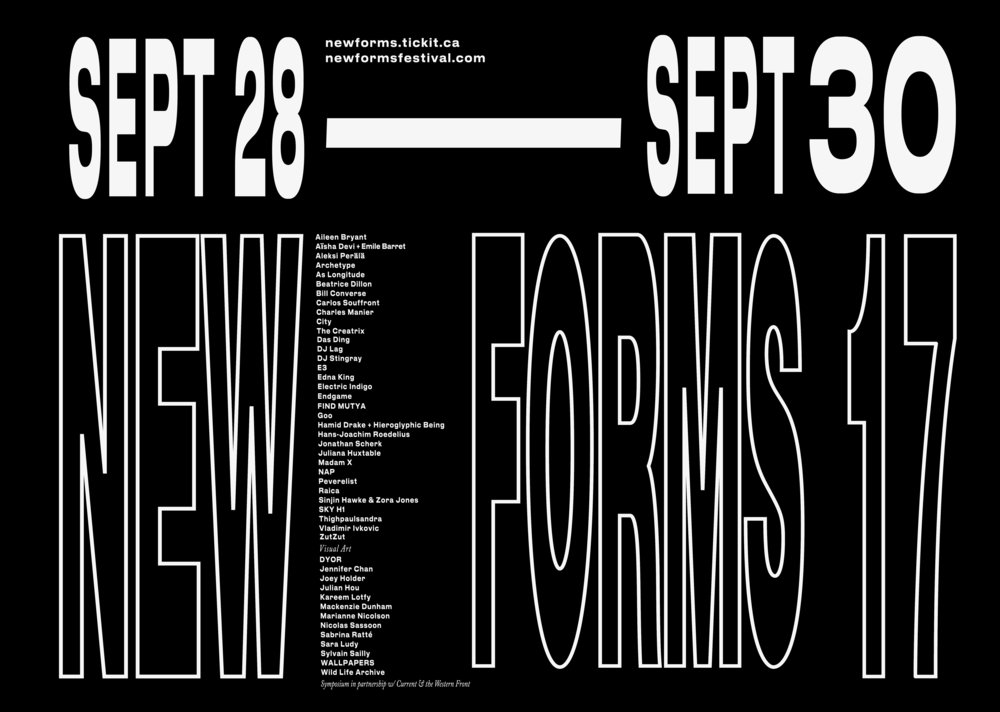
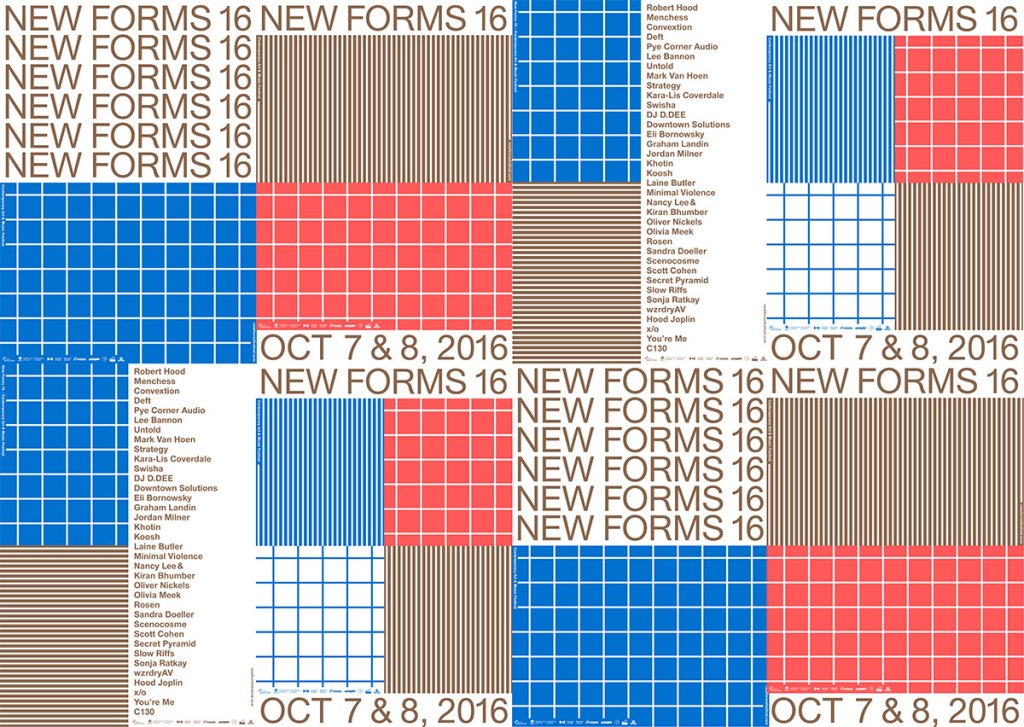
New Forms Media Society (NFMS) is a non-profit society and media arts organization founded in 2000 that exists to unite creative communities, push artistic and conceptual boundaries, and explore digital media as an art form. By producing the annual New Forms Festival (NFF) as well as a growing schedule of year-round public presentations, we aim to raise the profile of Canadian artists, media arts, underground and subversive arts movements and practices both in Canada and abroad. NFMS is dedicated to showcasing innovative media works that generate a critical and creative discourse within the public sphere.

By promoting Canadian artists in collaboration with the international arts and technology world, New Forms facilitates multimodal art works and engages in discussion on their role in our cultural environment. Since its inception, an integral element of New Forms is the recognition of independent and groundbreaking artists. The New Forms Festival aims to showcase and increase awareness of these artists and their work within our community and beyond by promoting them within a larger milieu.

New Forms Festival is part of a larger, international, multi-media festival movement, which explores the ever changing and evolving world of art and creates a platform for artistic growth. The Society’s goal is to make new media art, music, film, technology-based installation and performance accessible to a wider audience. [1]

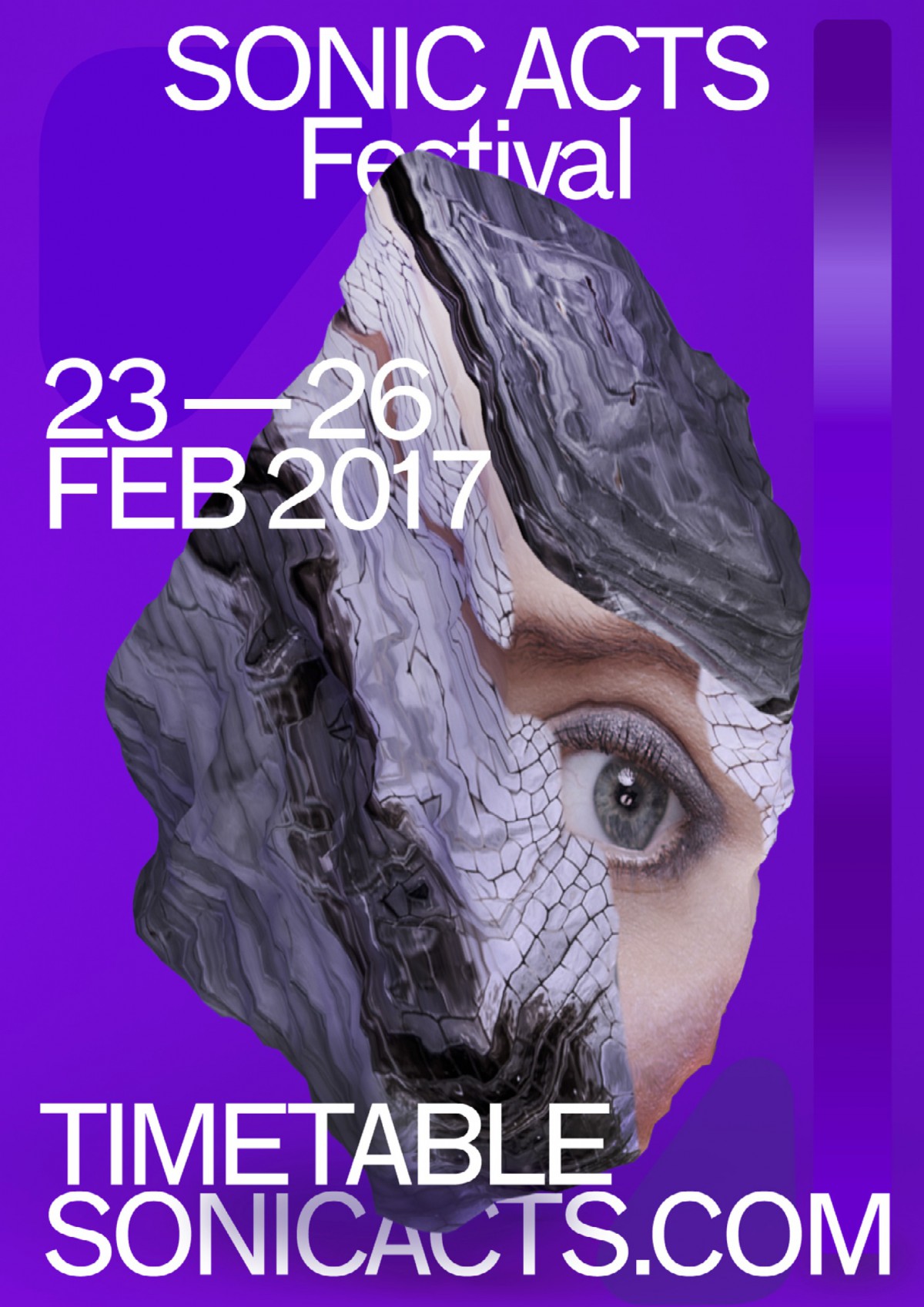
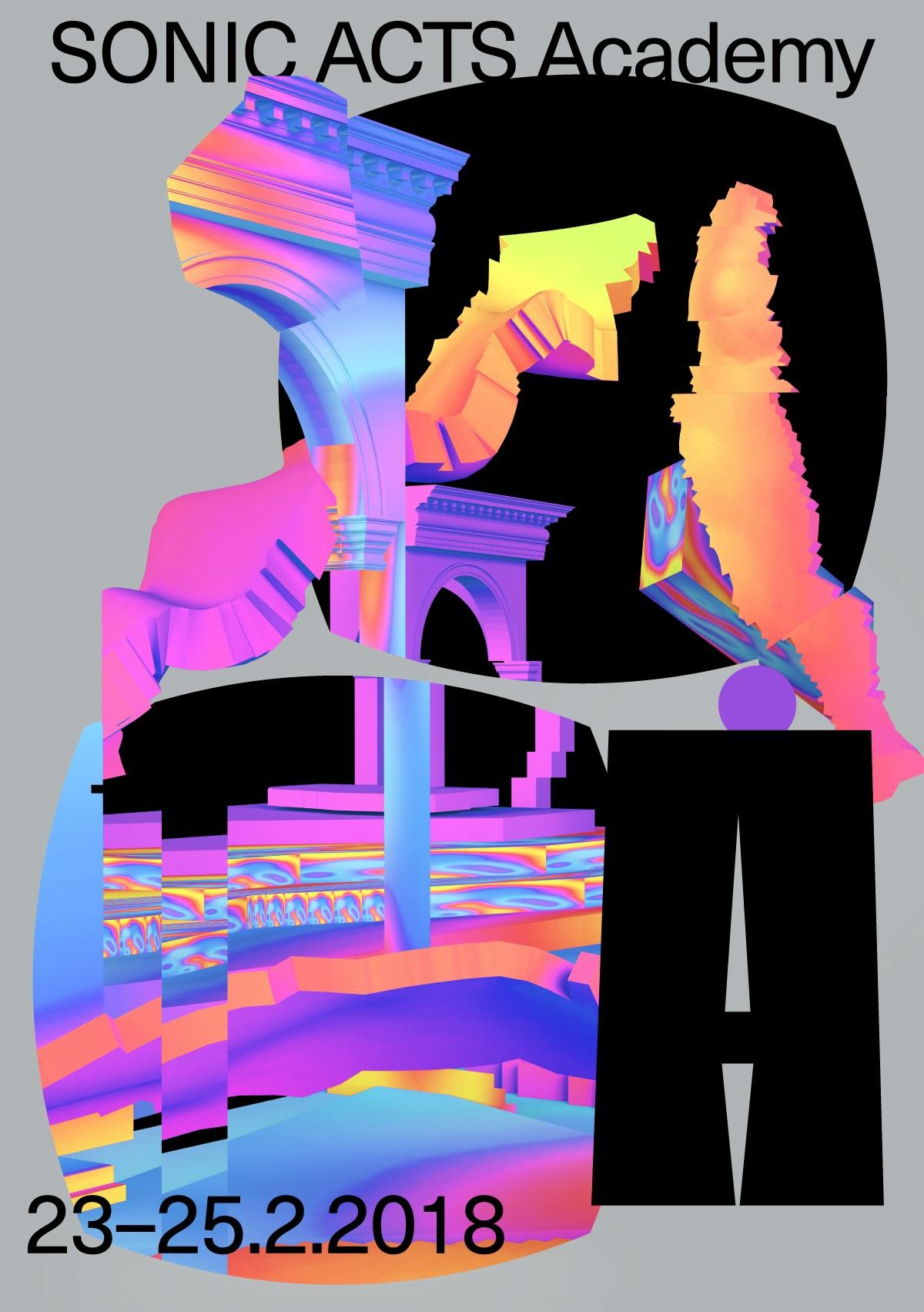
Sonic Acts was founded in 1994. Over the years, it has established itself as a thematic festival with a strong focus on contemporary and historical developments at the intersections of art, technology, music and science. Each festival edition explores the chosen theme by means of an international conference, a wide range of concerts and performances, exhibitions and screenings, and embraces a broad spectrum of fields, practices and disciplines.

Sonic Acts has developed into an organisation for the research, development and production of works at the intersection of art, science and theory. It also commissions and co-produces new works, often in collaboration with international festivals, arts organisations, funders and other partners. Recent projects include the three-year art, research & commissioning project Dark Ecology, predominantly taking place in the Arctic region, and its globally touring programme Vertical Cinema. [1]

From Wikipedia:

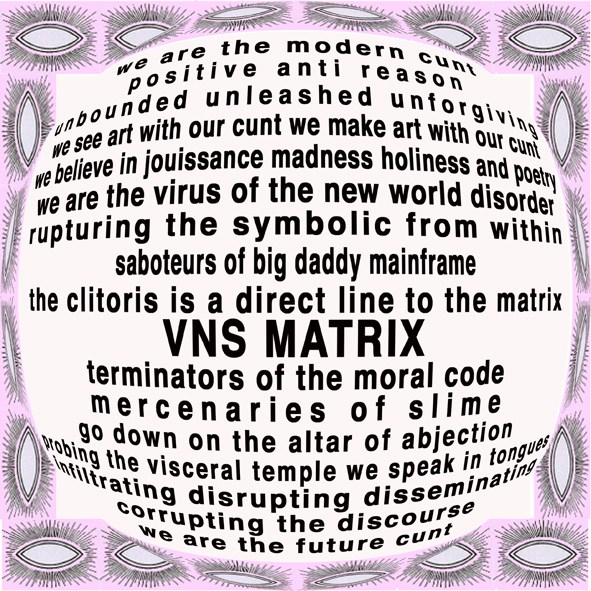
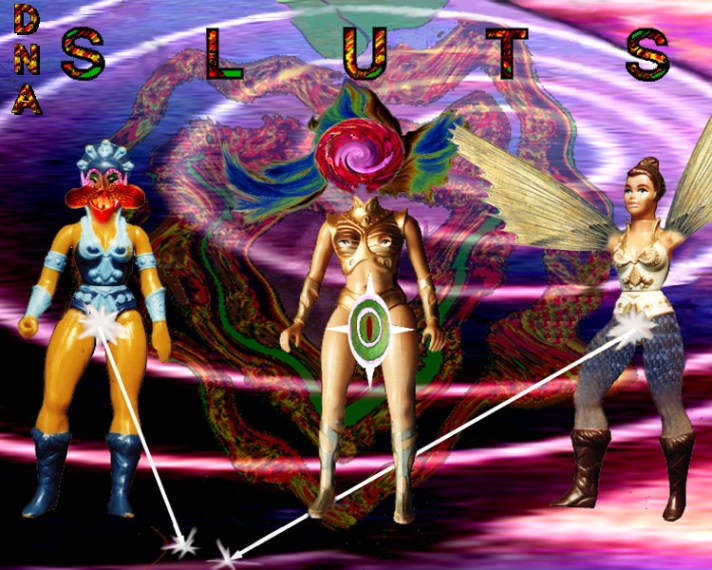
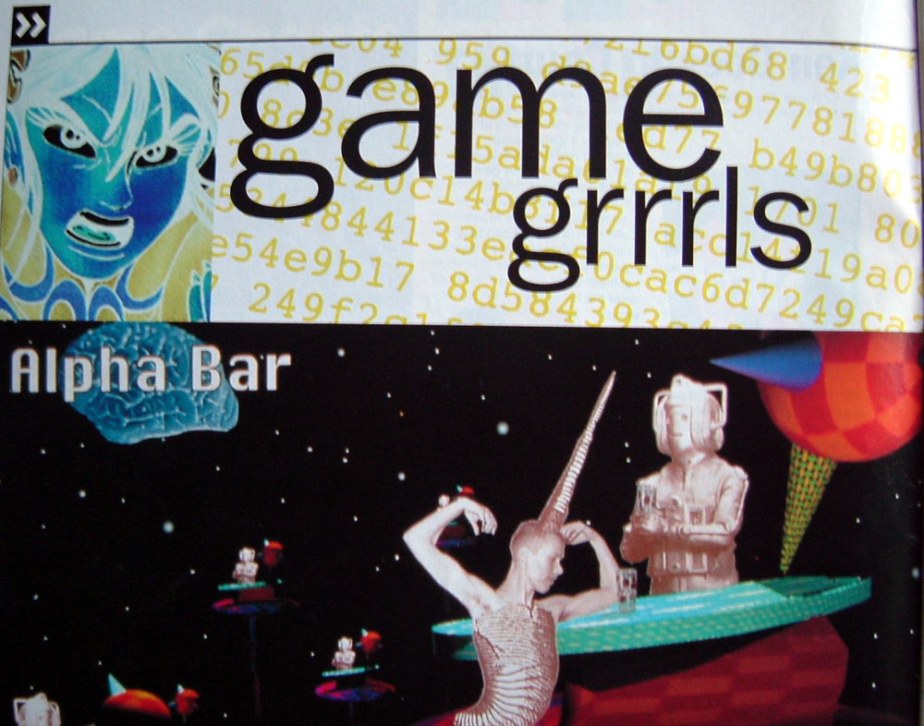
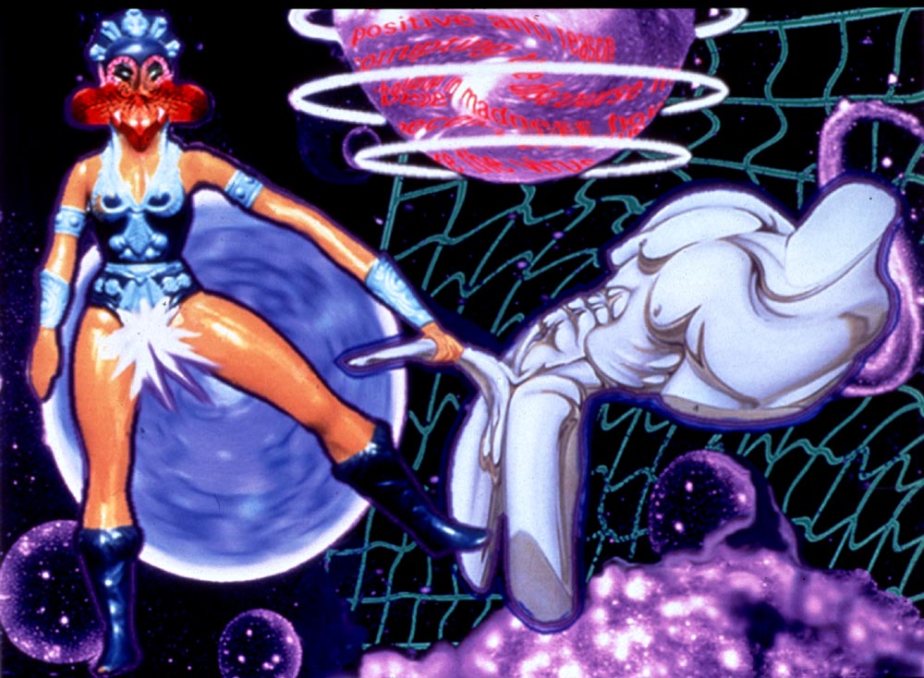
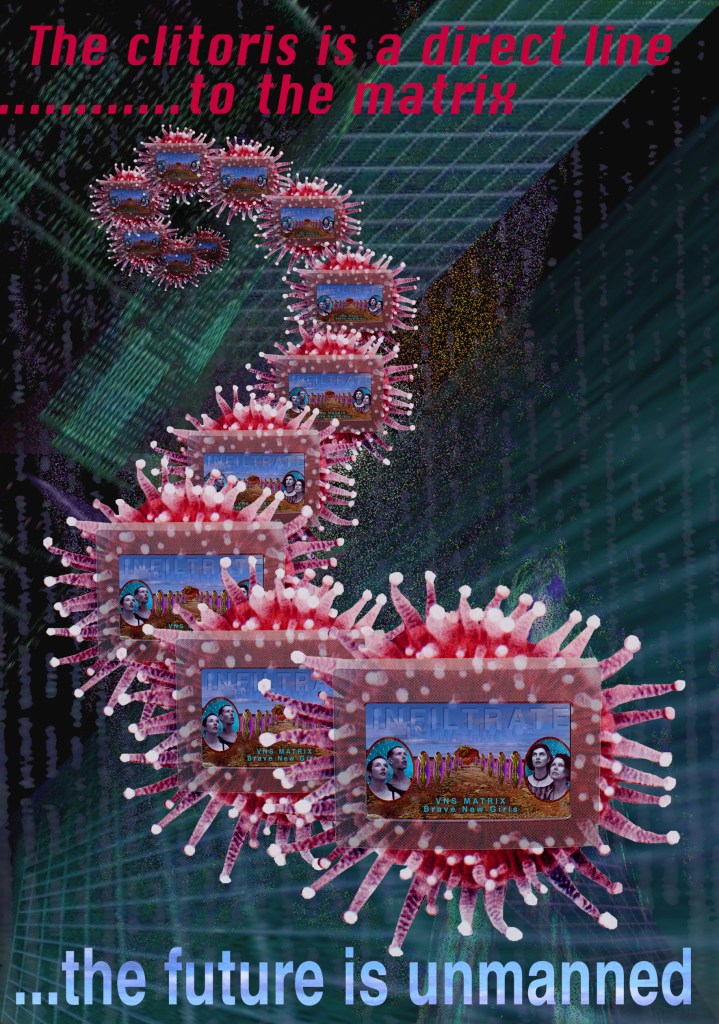
VNS Matrix was an artist collective founded in Adelaide, Australia, in 1991, by Josephine Starrs, Julianne Pierce, Francesca da Rimini and Virginia Barratt. Their work included installations, events, and posters distributed through the Internet, magazines, and billboards. Taking their point of departure in a sexualised and socially provocative relationship between women and technology the works subversively questioned discourses of domination and control in the expanding cyber space. They are credited as being amongst the first artists to use the term cyberfeminism to describe their practice.

From VNS Matrix:

The first of their works (a large scale billboard), inspired by such theorists as Donna Haraway and Sadie Plant, featured their seminal text “A Cyberfeminist Manifesto for the 21st Century”. It was in this manifesto that the term “cyberfeminism” first appeared, and this work was widely distributed. In the manifesto, VNS Matrix stated that, “we are the modern cunt/positive anti reason/unbounded unleashed unforgiving” and that, “we are the virus of the new world disorder/rupturing the symbolic from within/saboteurs of big daddy mainframe/the clitoris is a direct line to the matrix/the VNS Matrix”. The group disbanded in 1997, but occasionally work together on selected projects and presentations. Their parting manifesto “Bitch Mutant Manifesto” gave the finger to all technopatriarchies and capitalist infospheres with the words “suck my code” amongst other blasphemous exhortations.

Cory Arcangel (born May 25, 1978) is a Brooklyn, New York post-conceptual artist who makes work in many different media, including drawing, music, video, performance art, and video game modifications, for which he is perhaps best known.

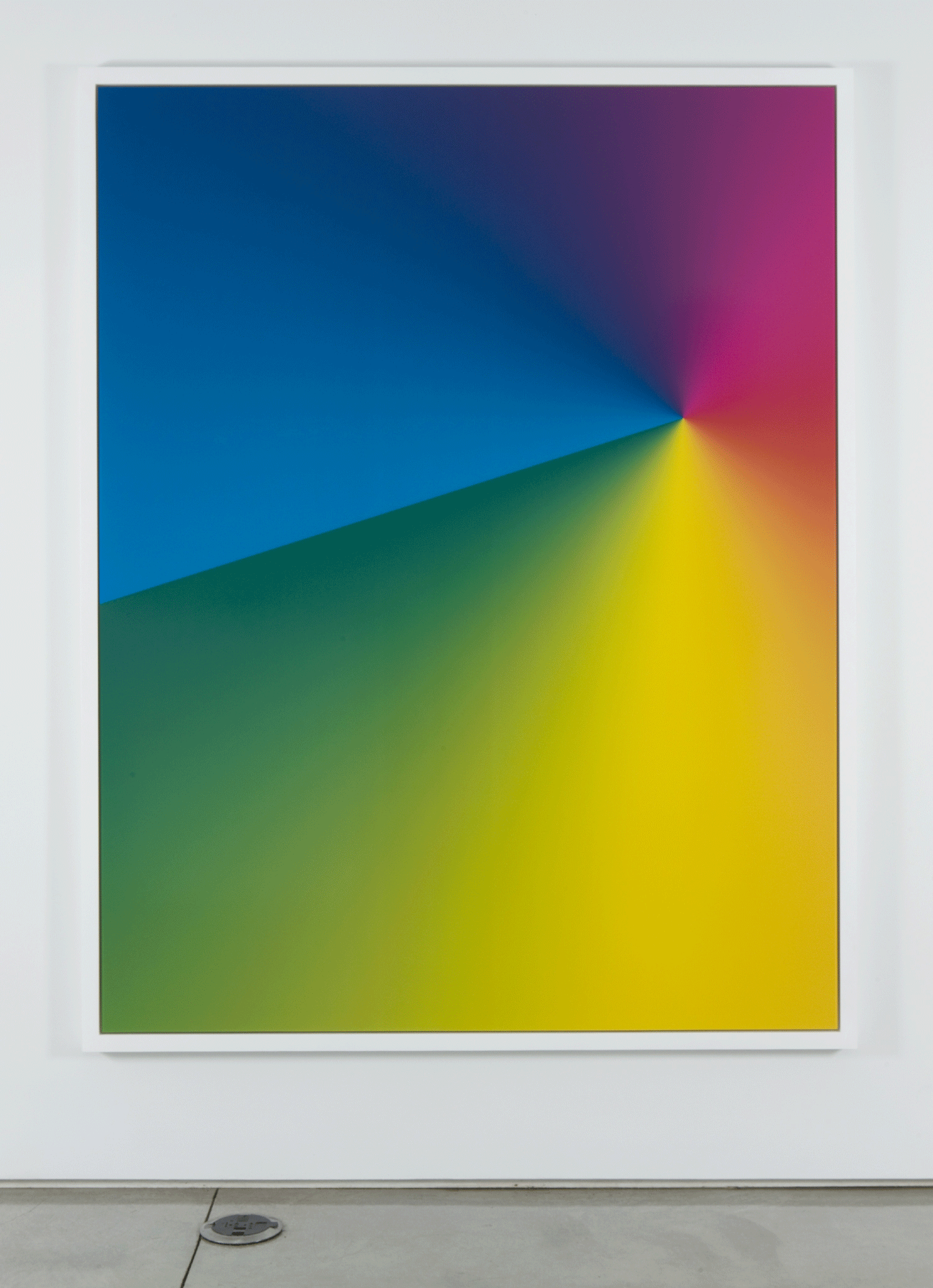
Arcangel often uses the artistic strategy of appropriation, creatively reusing existing materials such as dancing stands, Photoshop gradients and YouTube videos to create new works of art. His work explores the relationship between digital technology and pop culture. He is a recipient of a 2006 Creative Capital Emerging Fields Award. [1]

Notable Works:

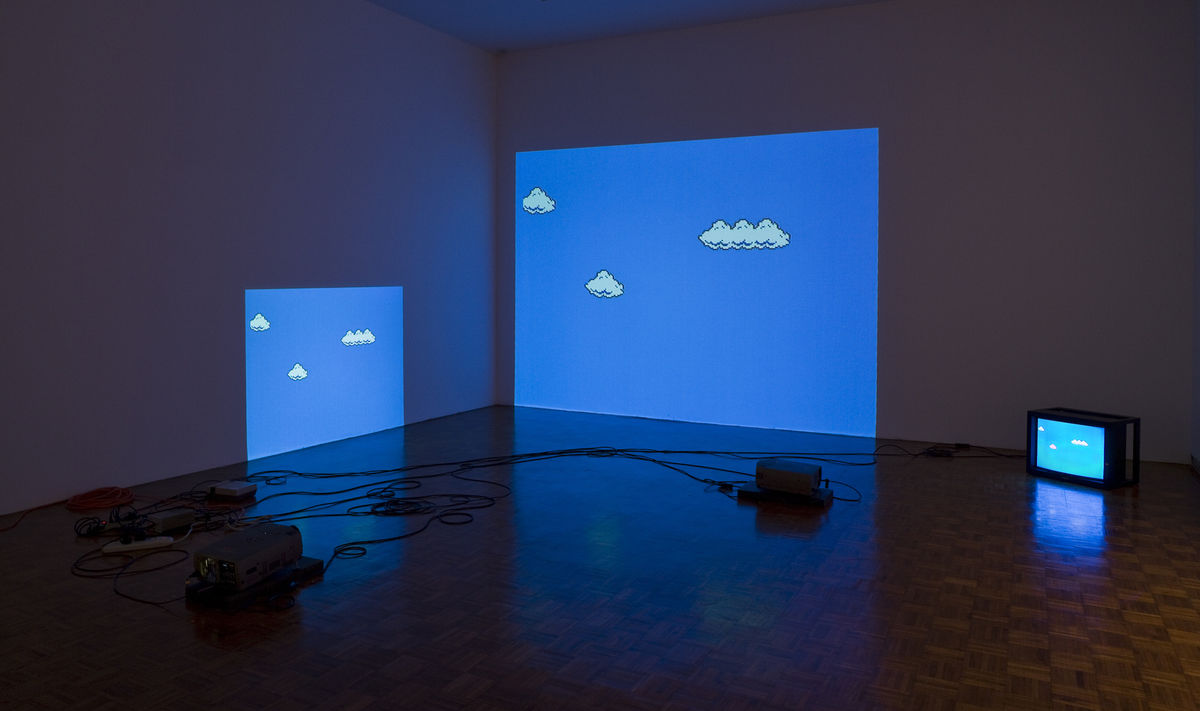
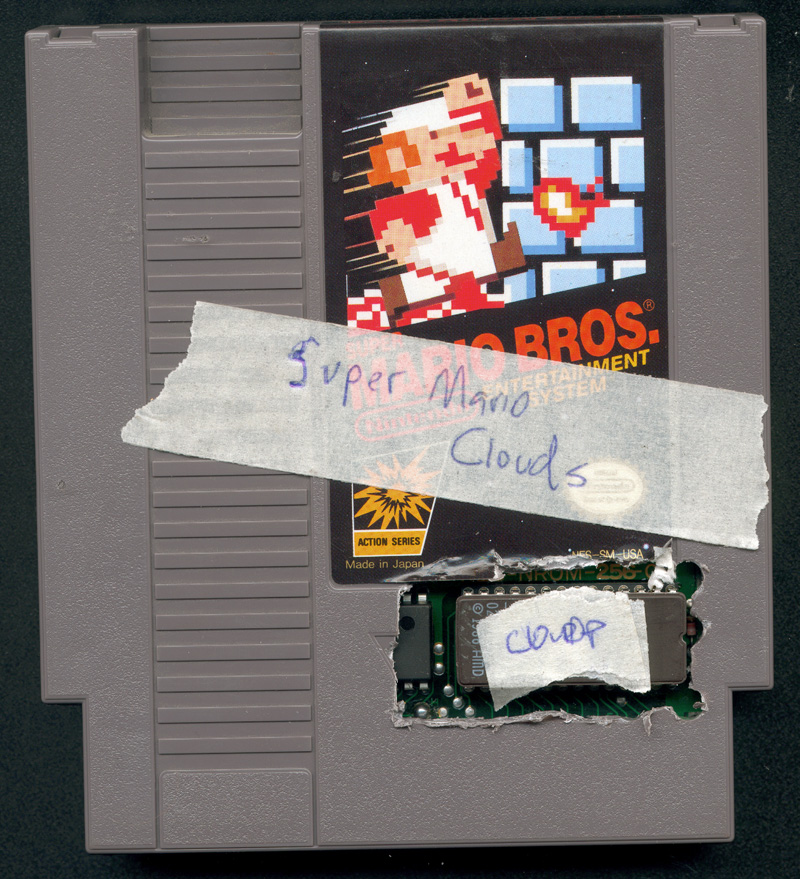
Super Mario Clouds Arcangel's best known works are his Nintendo game cartridge hacks and reworkings of obsolete computer systems of the 1970s and 80s. One example is Super Mario Clouds (2002), a modified version of the video game Super Mario Bros. for Nintendo's NES game console in which all of the game's graphics have been removed, leaving a blue background with white clouds scrolling slowly from right to left. [1]

Pizza Party Pizza Party (2004) was a free, functional software package that could be used to order Domino's Pizza through a command-line interface. The program allowed users to order pizza by typing in commands such as pizza_party -pmx 2 medium regular, which - according to the artist - would order two medium crust pizzas with pepperoni, mushrooms and extra cheese. The piece was commissioned by Eyebeam and implemented by Mike Frumin. [1]

Punk Rock 101 Punk Rock 101 (2006) is an example of Arcangel's work with the web as an artistic medium. For this piece, he re-published Kurt Cobain's alleged suicide letter alongside a series of Google Ads. The ads are tailored to the content of any given page, and the piece juxtaposed Cobain's angst with ads selling social anxiety treatment and motivational speaking. Art critic Paddy Johnson wrote of the work, "This is quite possibly the most brilliant subversion of the medium I have seen." [1]