foundyou.online - Directory for New Media Art
Open Filters
artists (30)artworks (20)orgs (59)events (15)

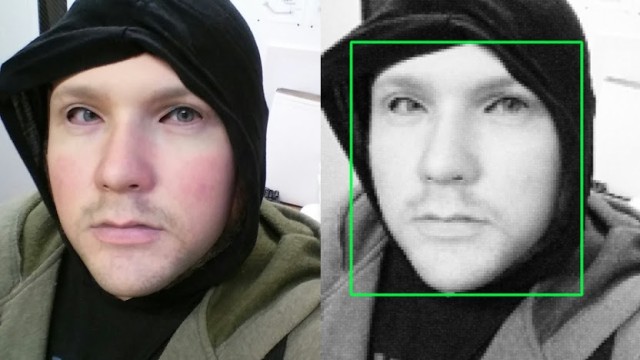
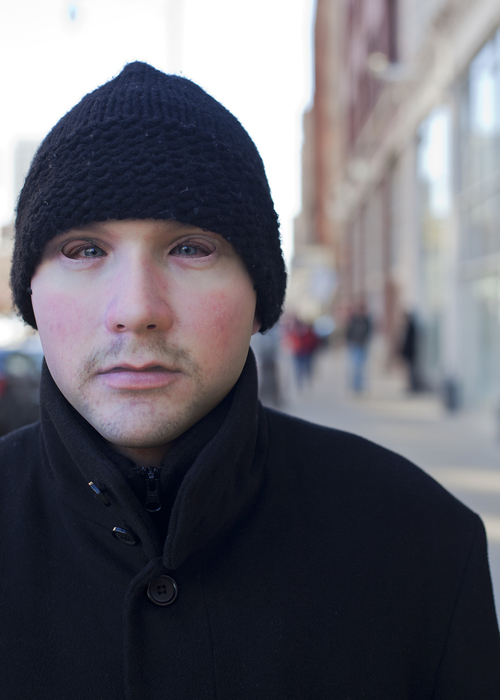
From URME Surveillance:

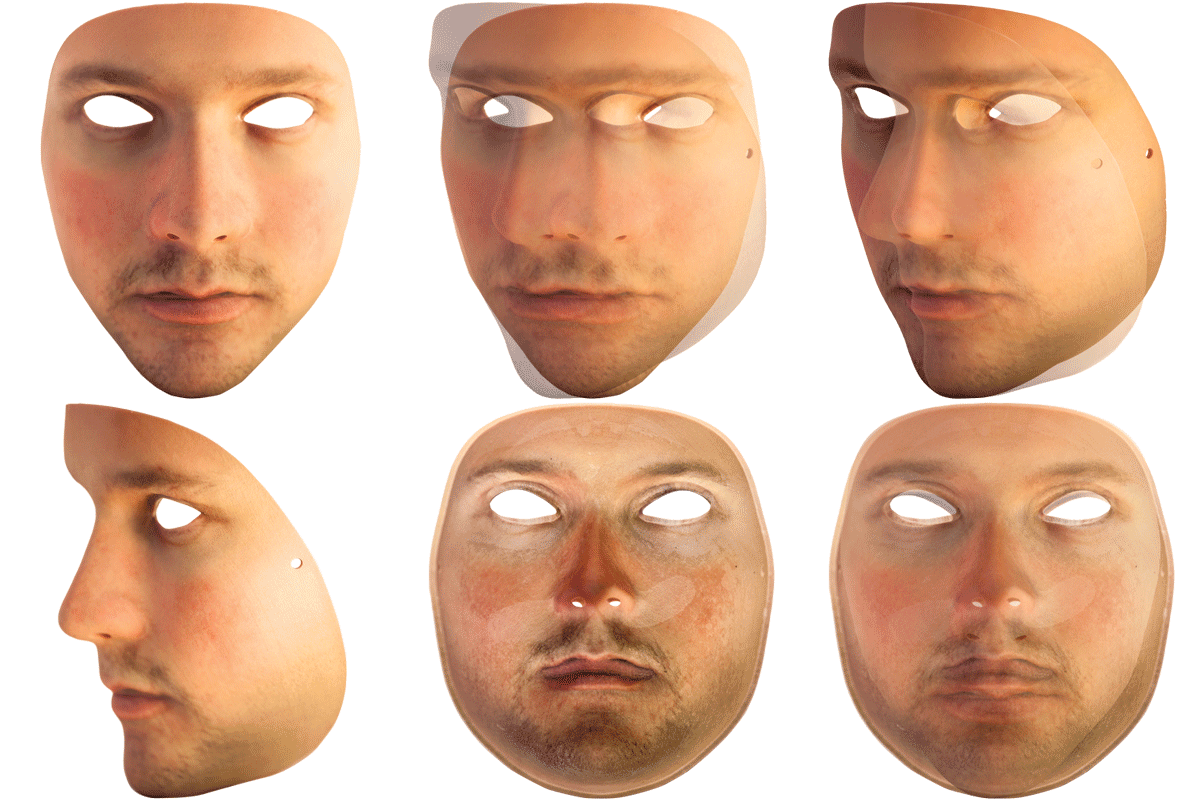
The URME Personal Surveillance Identity Prosthetic demonstrates the latest in 3D printing technology. Made from a pigmented hard resin, this mask is both a 3D scan of artist Leo Selvaggio's face, as well as photo realistic rendering of his features, such as skin tone, texture and hair. This technology is made possible by the folks over at ThatsMyFace.com. Their products have been seen on CNN, MSNBC, Gizmodo, The Big Bang Theory, and now on URME Surveillance.

People have been hiding from surveillance since the begining of networked cameras. Unfortunately wearing a ski mask in public makes you a pretty easy target. its fairly easy to track on camera, and even if the camera doesn't see you, EVERYONE else will. "Why is that dude wearing a ski mask?" Etc, etc. In response, URME Surveillance has developed a state of the art identity replacement tech in the Personal Surveillance Identity Prosthetic. The basic gist is that rather than hide from cameras, simply give them a face other than your own to track without drawing attention to yourself in a crowd. In other words, when you're out in the world doing whatever you are doing, all your actions, which are being recorded are documented as the actions of someone other than yourself, freeing you from any threat of surveillance.
From Wikipedia:

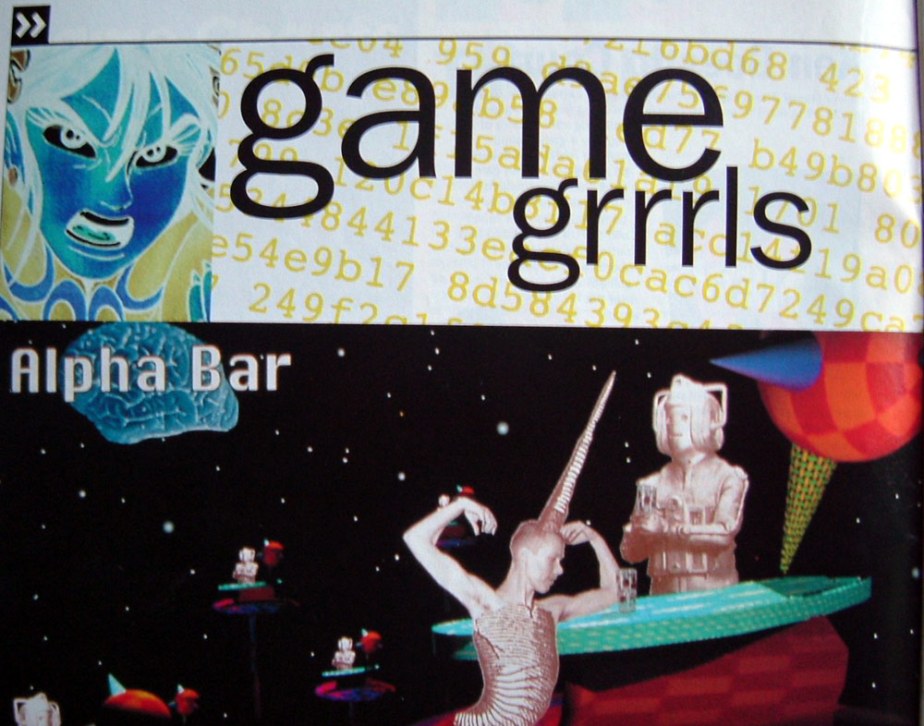
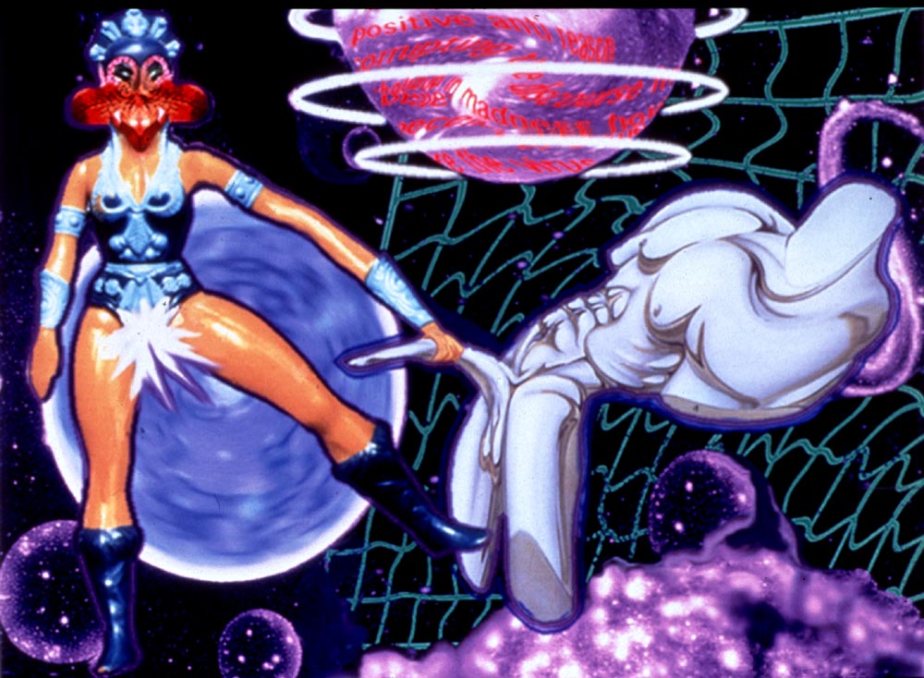
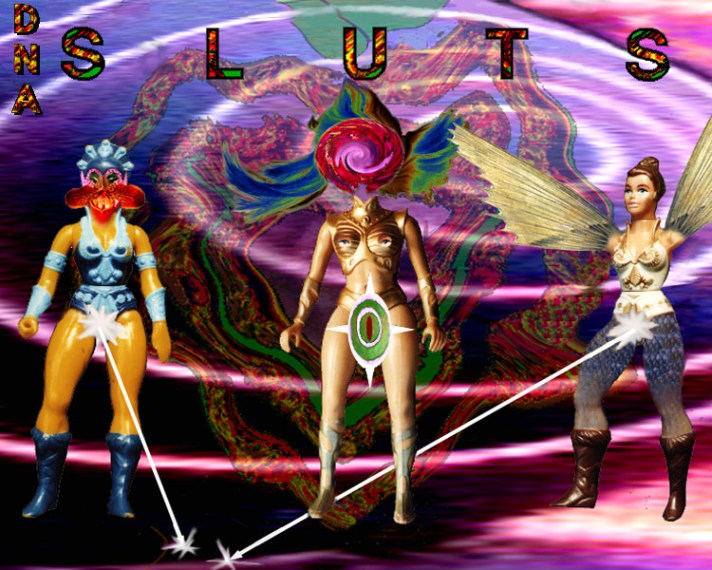
VNS Matrix was an artist collective founded in Adelaide, Australia, in 1991, by Josephine Starrs, Julianne Pierce, Francesca da Rimini and Virginia Barratt. Their work included installations, events, and posters distributed through the Internet, magazines, and billboards. Taking their point of departure in a sexualised and socially provocative relationship between women and technology the works subversively questioned discourses of domination and control in the expanding cyber space. They are credited as being amongst the first artists to use the term cyberfeminism to describe their practice.

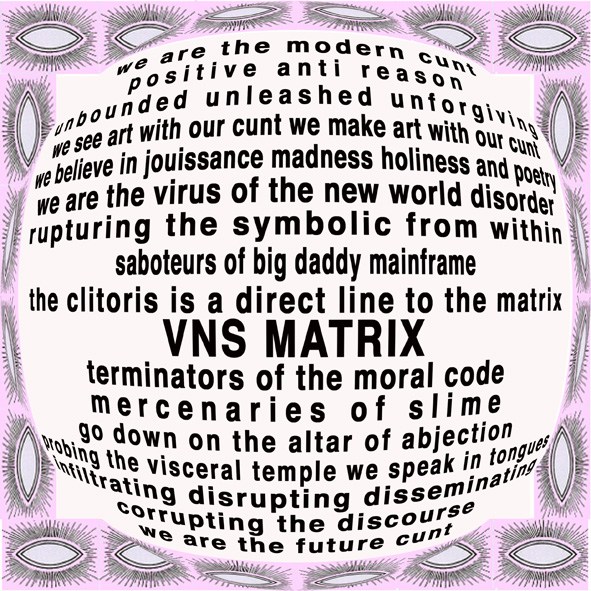
From VNS Matrix:

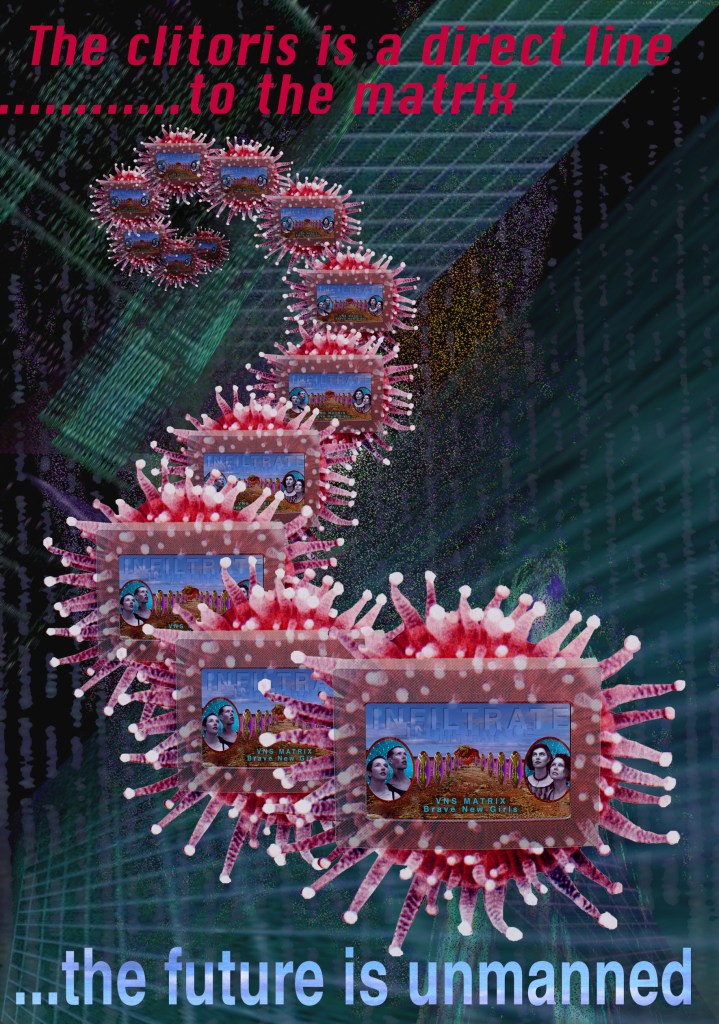
The first of their works (a large scale billboard), inspired by such theorists as Donna Haraway and Sadie Plant, featured their seminal text “A Cyberfeminist Manifesto for the 21st Century”. It was in this manifesto that the term “cyberfeminism” first appeared, and this work was widely distributed. In the manifesto, VNS Matrix stated that, “we are the modern cunt/positive anti reason/unbounded unleashed unforgiving” and that, “we are the virus of the new world disorder/rupturing the symbolic from within/saboteurs of big daddy mainframe/the clitoris is a direct line to the matrix/the VNS Matrix”. The group disbanded in 1997, but occasionally work together on selected projects and presentations. Their parting manifesto “Bitch Mutant Manifesto” gave the finger to all technopatriarchies and capitalist infospheres with the words “suck my code” amongst other blasphemous exhortations.

From transparencygrenade.com:

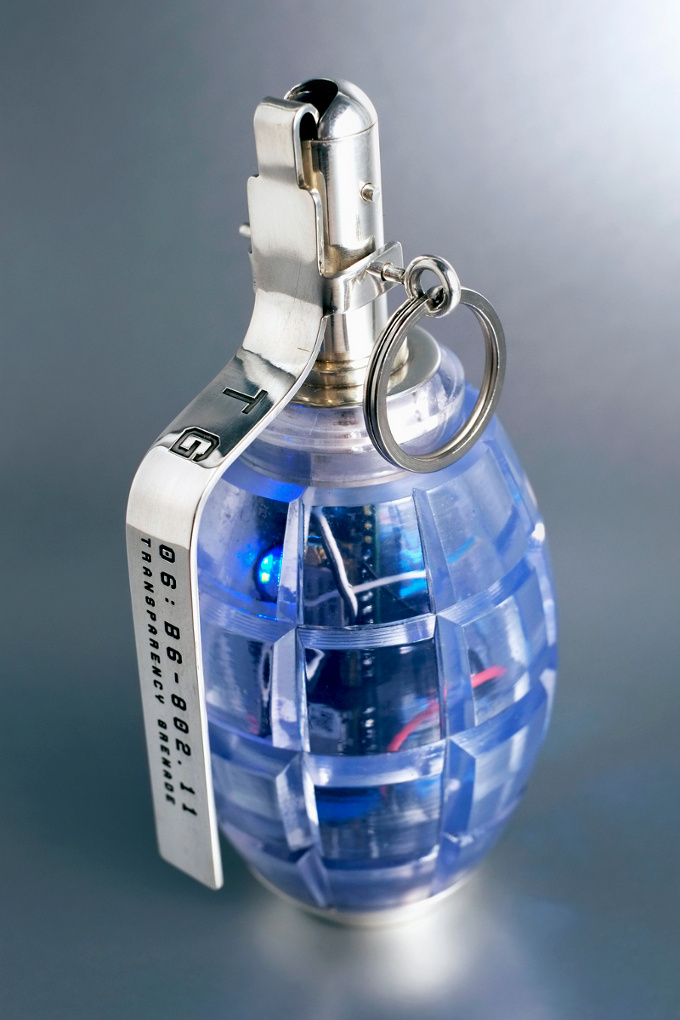
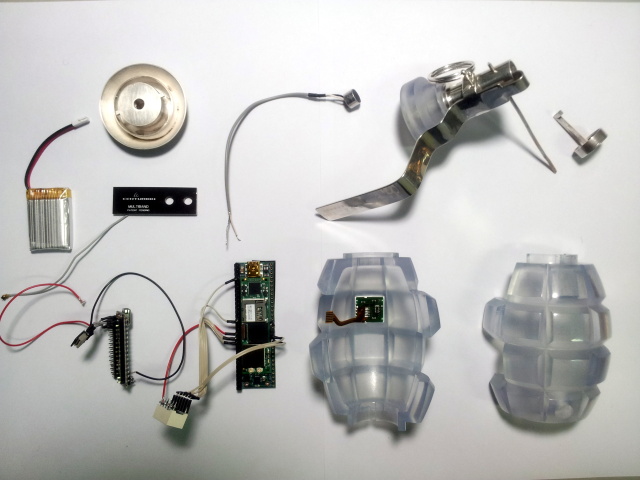
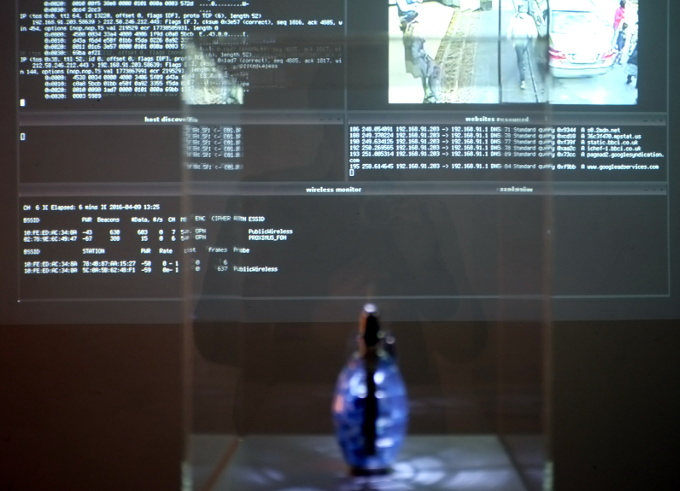
Equipped with a tiny computer, microphone and powerful wireless antenna, the Transparency Grenade captures network traffic and audio at the site and securely and anonymously streams it to a dedicated server where it is mined for information. User names, hostnames, IP addresses, unencrypted email fragments, web pages, images and voice extracted from this data and then presented on an online, public map, shown at the location of the detonation.

The volatility of information in networked, digital contexts frames a precedent for clamouring (and often unrealistic) attempts to contain it. This increasingly influences how we use networks and think about the right to information itself; today we see the fear of the leak actively exploited by law makers to afford organisations greater opacity and thus control..

This anxiety, this 'network insecurity', impacts not just upon the freedom of speech but the felt instinct to speak at all. It would now seem letting public know what's going on inside a publicly funded organisation is somehow to do 'wrong' -Bradley Manning a sacrificial lamb to that effect..

Meanwhile, civil servants and publicly-owned companies continue to make decisions behind guarded doors that impact the lives of many, often leaving us feeling powerless to effect change, both in and out of a democratic context.

The Transparency Grenade seeks to capture these important tensions in an iconic, hand-held package while simultaneously opening up a conversation about just how much implicit trust we place in network infrastructure; infrastructure that reaches ever more deeply into our lives.

The LabThe Lab's logo, designed by Colpa PressThe LabThe Lab (San Francisco)

From The Lab:

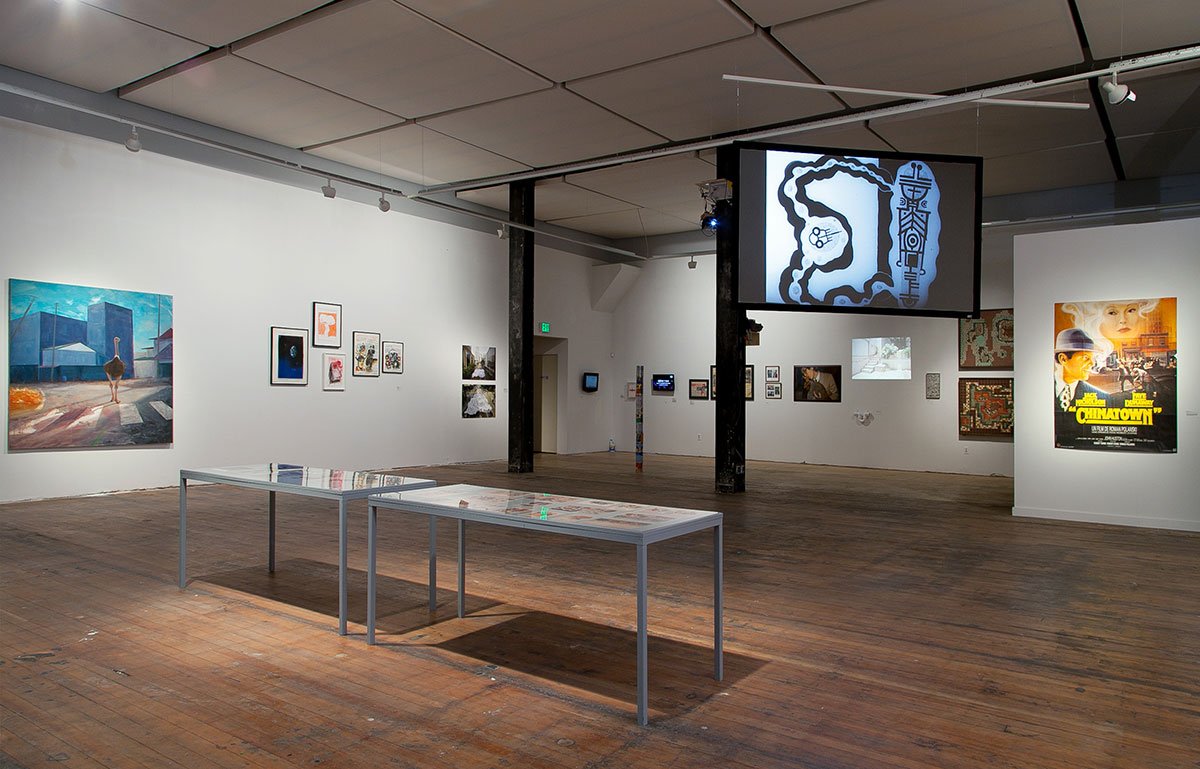
The Lab gives funding, time, and space to traditionally underrepresented artists and art forms. The organization intentionally focuses on supporting and amplifying the work of experimental artists who identify as African and African-American; Latinx; Asian and Asian-American; Arab and Arab-American; Indigenous American; Pacific Islander; lesbian, gay, bisexual, transgender, queer; differently-abled; and female. We seek to reach visionary artists whose economic and cultural realities have been ignored for too long, to the impoverishment of us all. The Lab is, above all, a catalyst for artistic experimentation. As a site of ongoing iteration and indeterminacy, it seeks to transform alongside artistic practices in order to engage meaningfully with diverse communities in San Francisco's Mission District and beyond.

We believe it is important to constantly question our own organizational model and to deeply engage with new artistic practices and modes of thinking around the arts. The Lab embodies the desires of creative, critical, and compassionate individuals. We want audiences to be inspired by the way we work, not just what we produce.

To that end, The Lab is W.A.G.E. Certified. W.A.G.E. Certification is a program initiated and operated by working artists that publicly recognizes nonprofit arts organizations demonstrating a commitment to voluntarily paying artist fees that meet a minimum standard.

From Wikipedia:

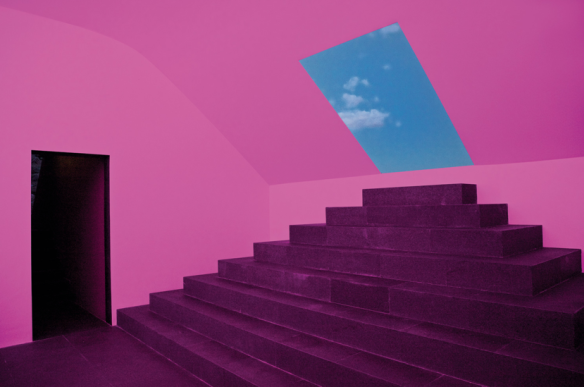
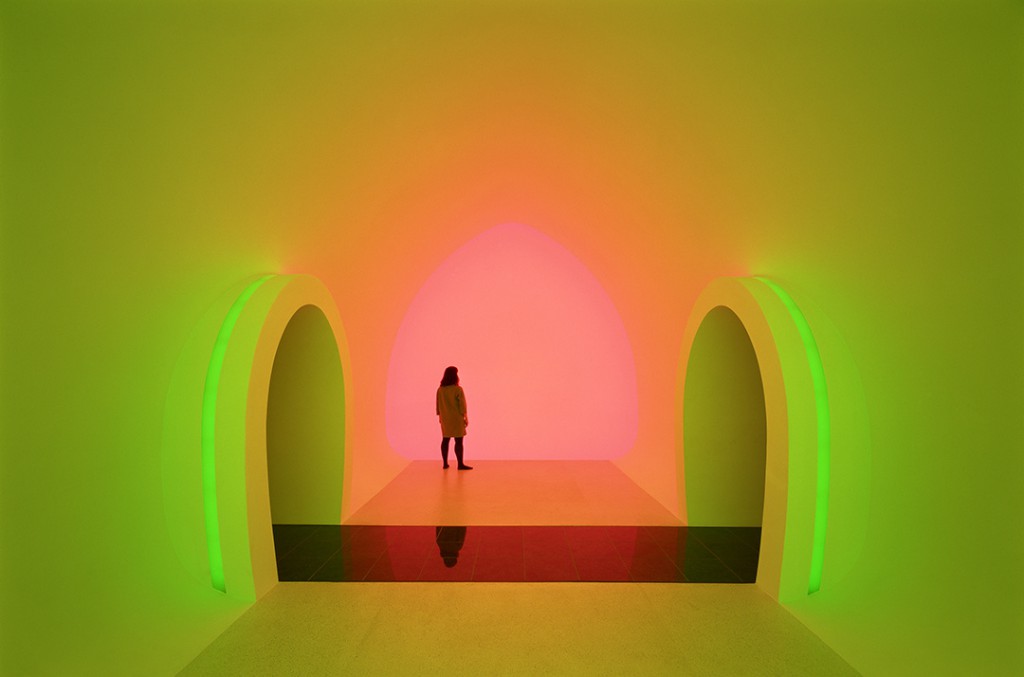
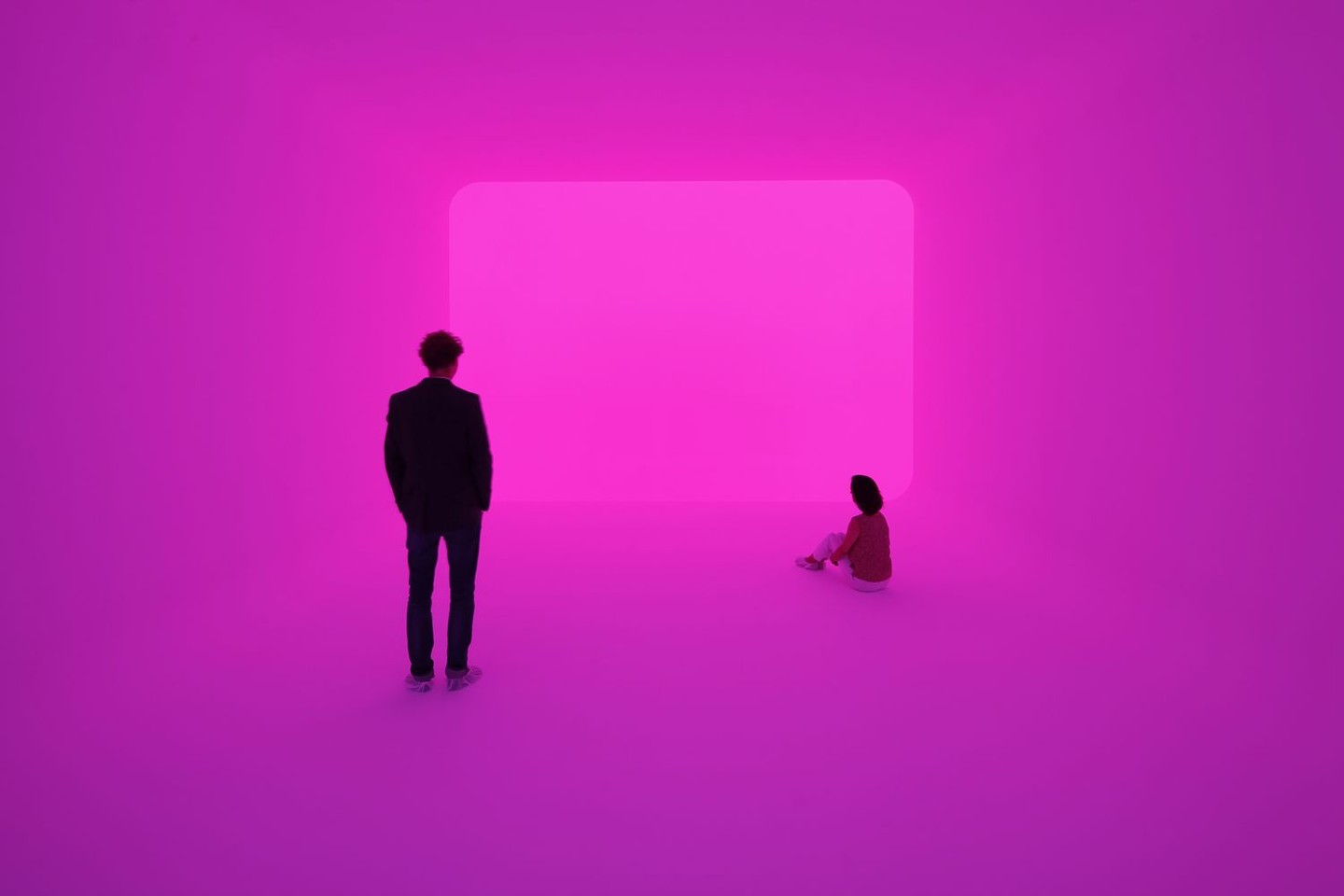
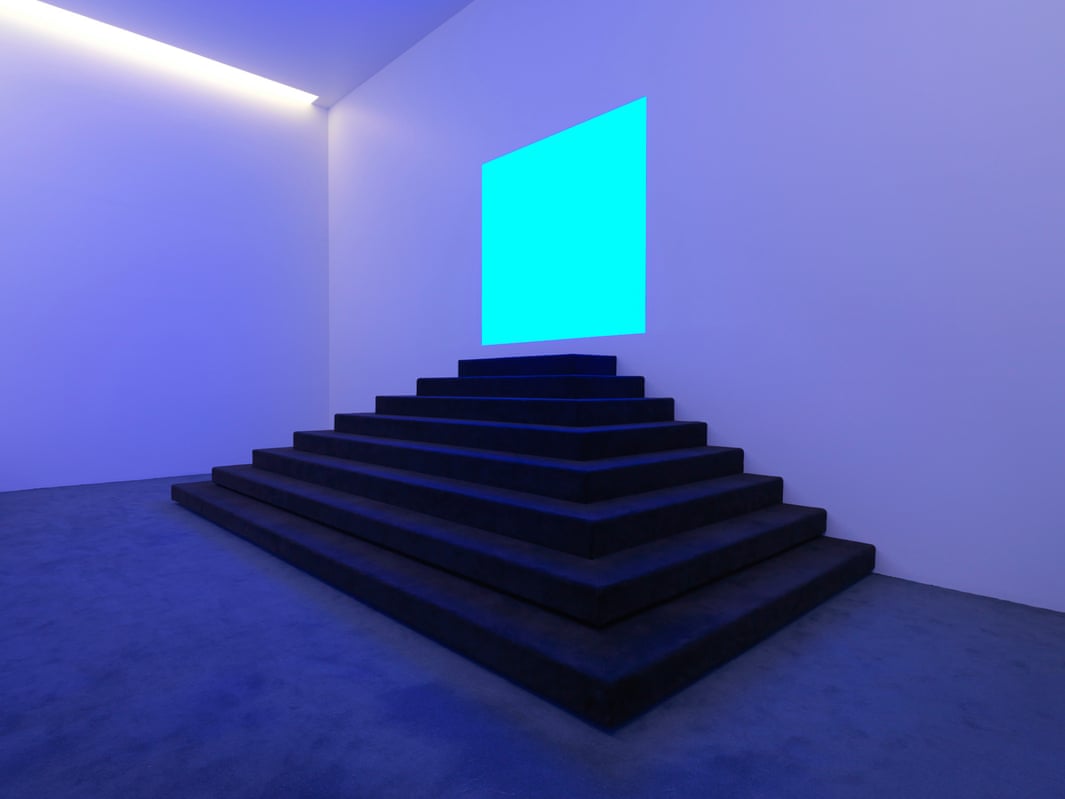
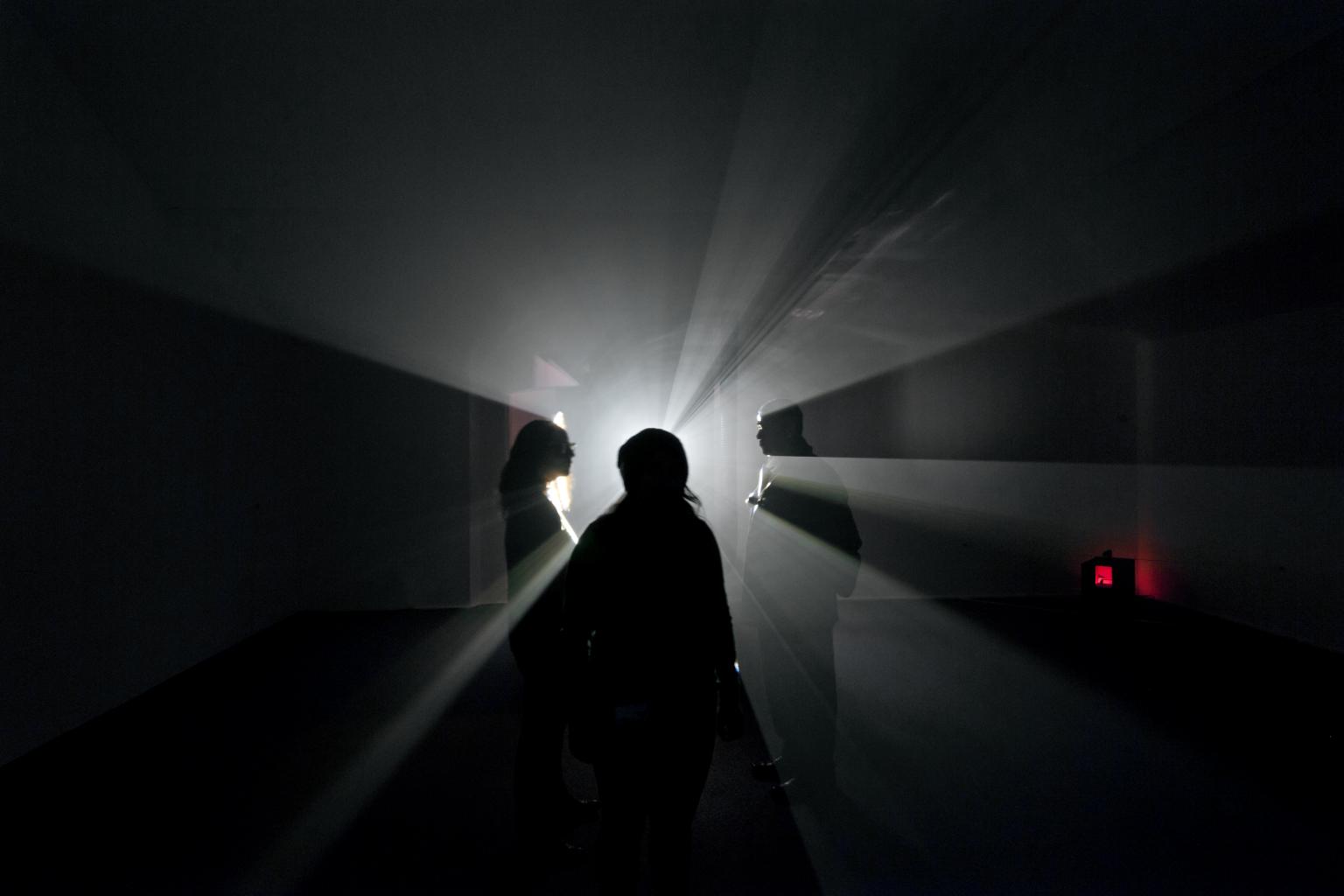
James Turrell (born May 6, 1943) is an American artist primarily concerned with Light and Space. Turrell was a MacArthur Fellow in 1984. Turrell is best known for his work in progress, Roden Crater, a natural cinder cone crater located outside Flagstaff, Arizona that he is turning into a massive naked-eye observatory.

Access to Roden Crater is limited to friends, though devoted fans can gain access by completing the "Turrell Tour", which involves seeing a Turrell in 23 countries worldwide. During May 2015, Roden Crater was open to a select group of 80 people, as part of a fund raiser, by allowing visits of 20 people per day during the course of four days, at a cost of $6,500 per person. As Roden Crater has been long shrouded in secrecy, fans have attempted to sneak in without the artist's permission. Some have succeeded.

In the 1970s, Turrell began his series of "skyspaces" enclosed spaces open to the sky through an aperture in the roof. A Skyspace is an enclosed room large enough for roughly 15 people. Inside, the viewers sit on benches along the edge to view the sky through an opening in the roof.

From Wikipedia:

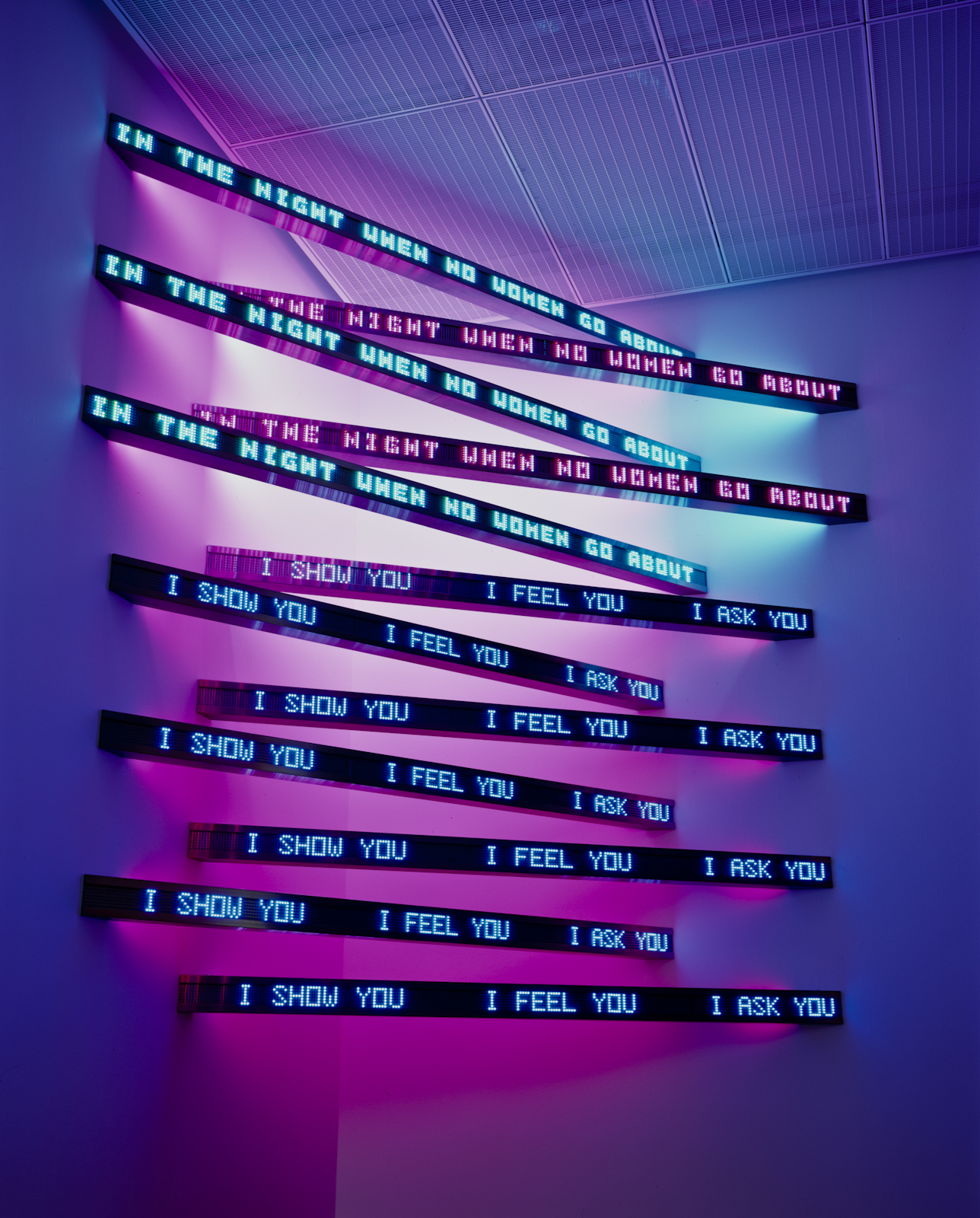
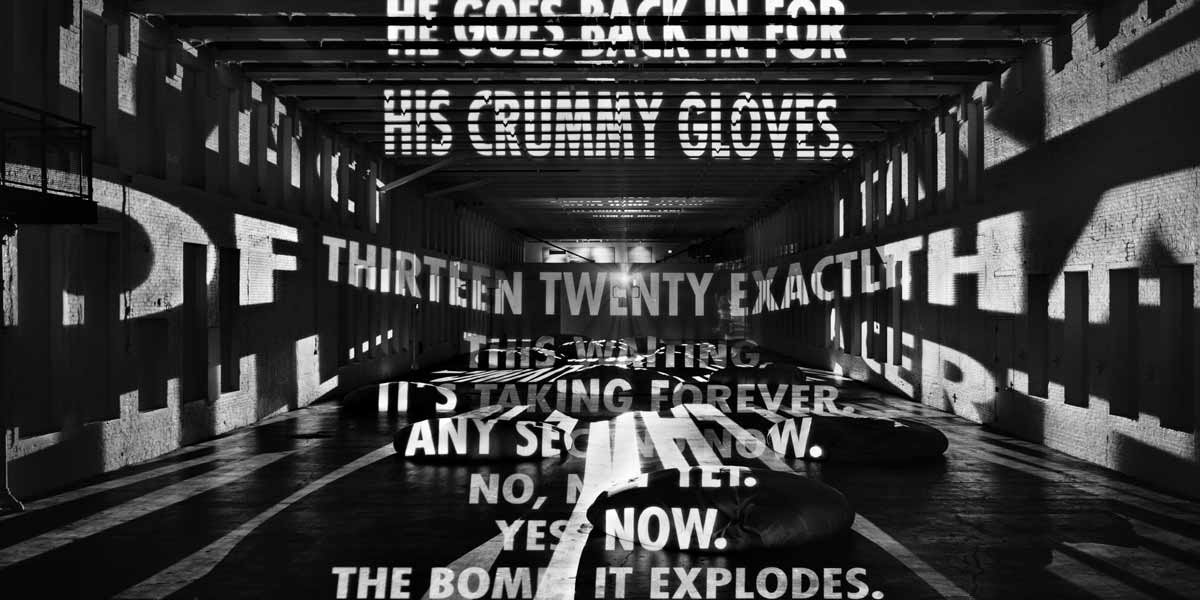
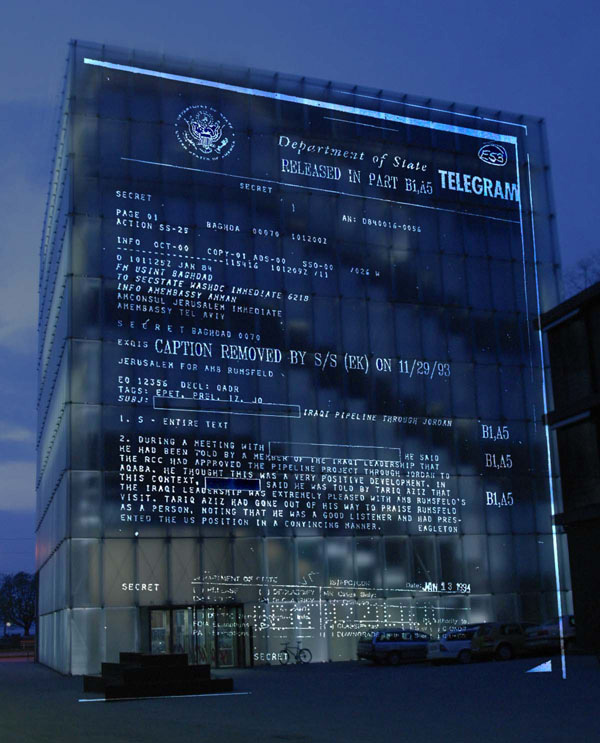
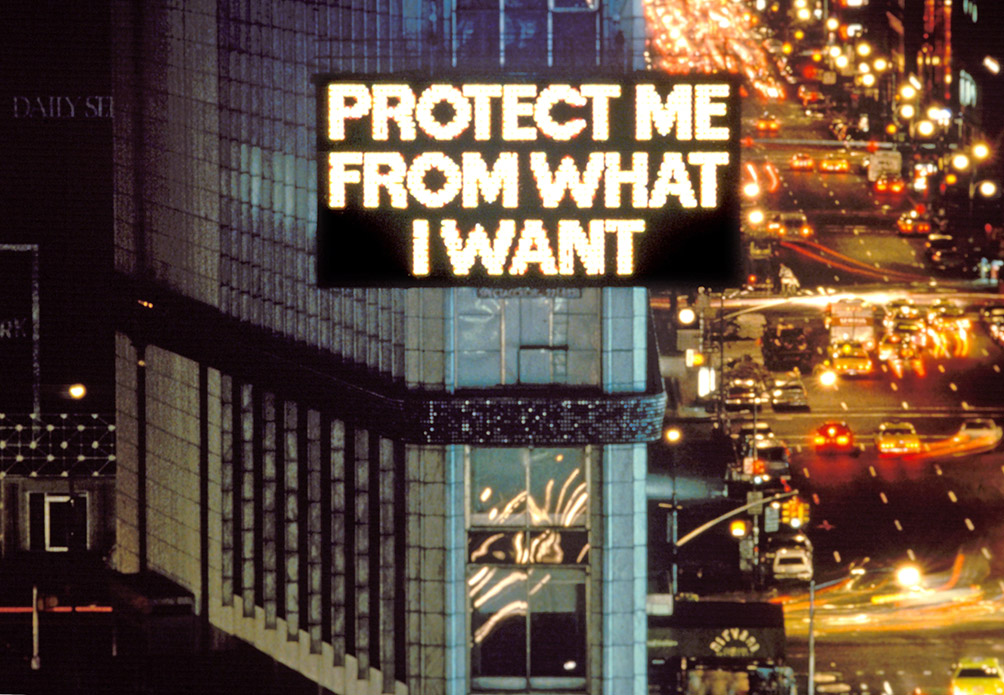
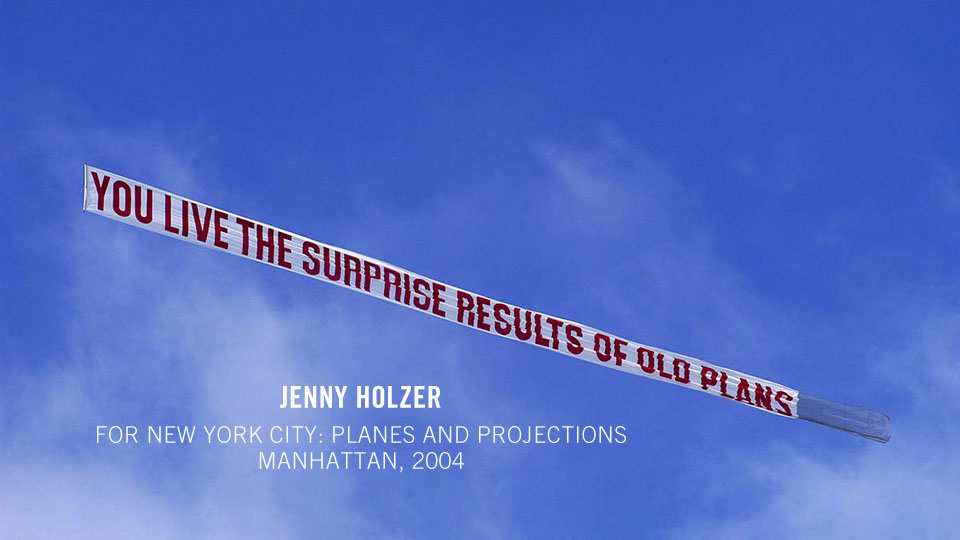
Jenny Holzer (born July 29, 1950, Gallipolis, Ohio) is an American neo-conceptual artist, based in Hoosick Falls, New York. The main focus of her work is the delivery of words and ideas in public spaces.

Holzer belongs to the feminist branch of a generation of artists that emerged around 1980, looking for new ways to make narrative or commentary an implicit part of visual objects. Her contemporaries include Barbara Kruger, Cindy Sherman, Sarah Charlesworth, and Louise Lawler.

The public dimension is integral to Holzer's work. Her large-scale installations have included advertising billboards, projections on buildings and other architectural structures, and illuminated electronic displays. LED signs have become her most visible medium, although her diverse practice incorporates a wide array of media including street posters, painted signs, stone benches, paintings, photographs, sound, video, projections, the Internet, and a race car for BMW. Text-based light projections have been central to Holzer’s practice since 1996. As of 2010, her LED signs have become more sculptural. Holzer is no longer the author of her texts, and in the ensuing years, she returned to her roots by painting.

From Wikipedia:

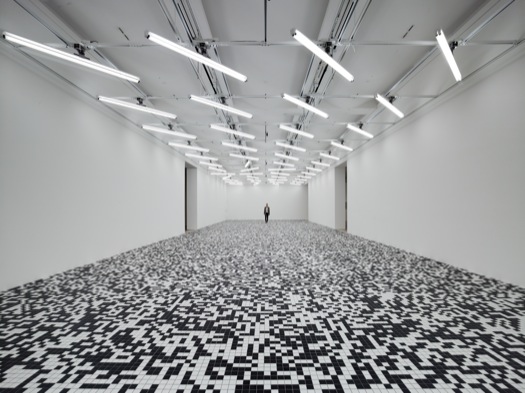
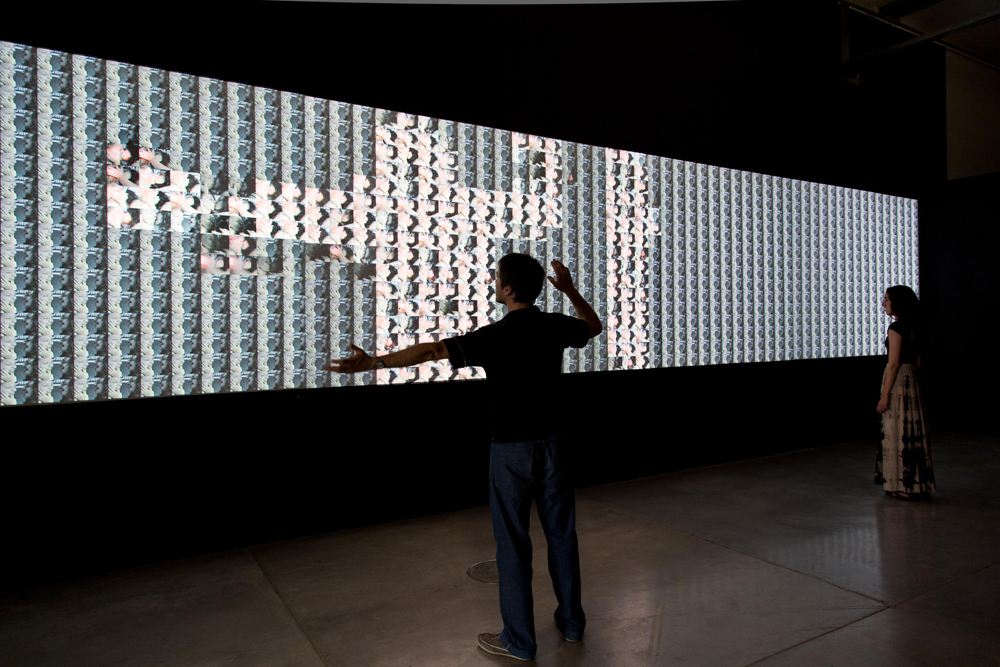
Lozano-Hemmer is best known for creating and presenting theatrical interactive installations in public spaces across Europe, Asia and America. Using robotics, real-time computer graphics, film projections, positional sound, internet links, cell phone interfaces, video and ultrasonic sensors, LED screens and other devices, his installations seek to interrupt the increasingly homogenized urban condition by providing critical platforms for participation. Lozano-Hemmer’s smaller-scaled sculptural and video installations explore themes of perception, deception and surveillance. As an outgrowth of these various large scale and performance-based projects Lozano-Hemmer documents the works in photography editions that are also exhibited.
From Wikipedia:

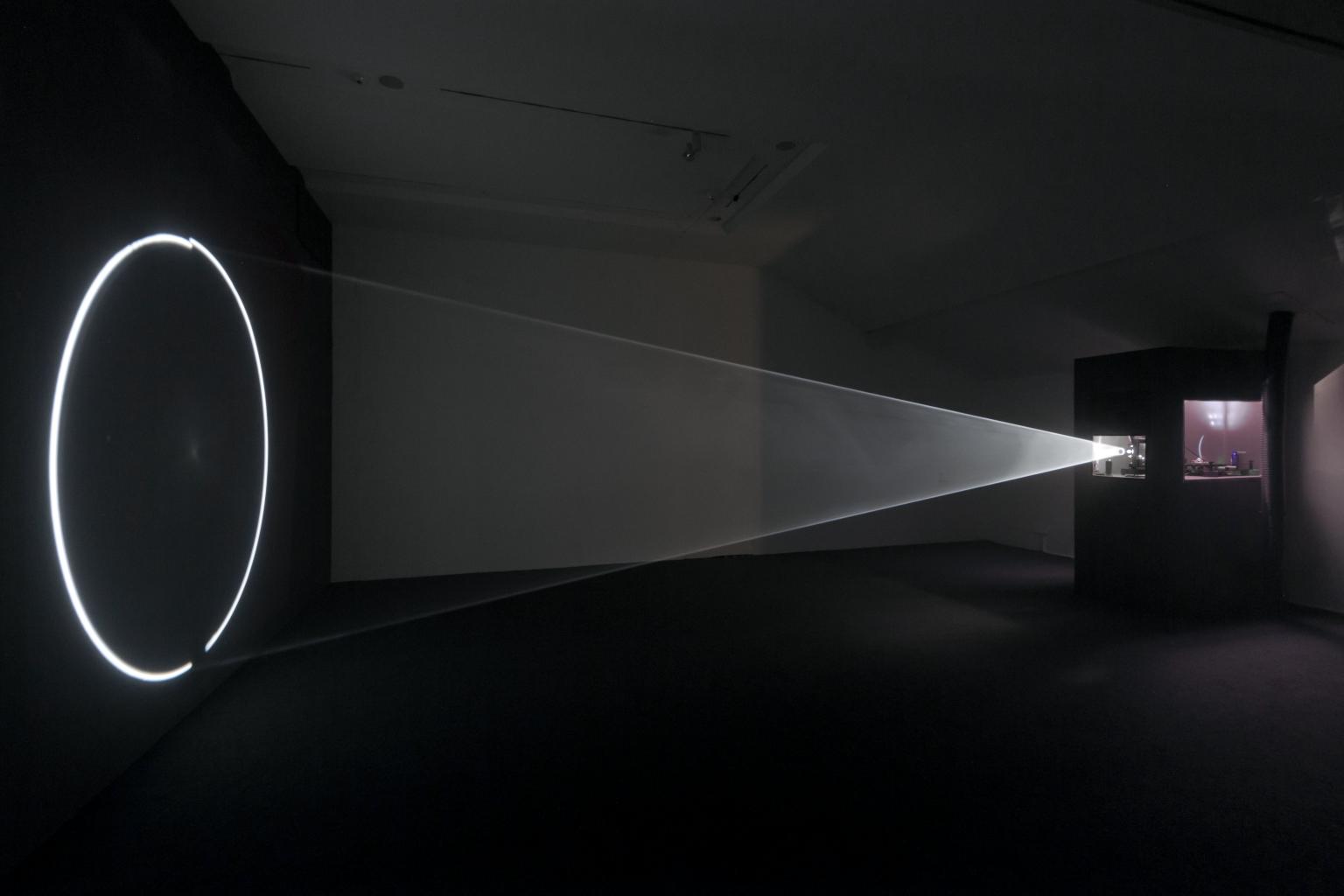
The idea for Line Describing a Cone came to McCall on his voyage from London to New York, where he produced the film in 1973. Though he had already created a number of other 16mm films, Line allowed him to actualize his ideas on the relationship between viewer and film and the medium of film itself. The thirty-minute film begins with a single white dot projected onto a black surface. As time progresses, the dot begins to form a curved line, tracing the circumference of a circle until the end of the line reaches its starting point. Meanwhile, particles in the air reveal the path of light in the space between the projector and the wall, making visible a cone of light. If the artist's display specifications are met, this beam of light projects between thirty and fifty feet. The circle that is projected onto the surface sits approximately twelve inches above the ground, and its diameter spans seven to nine feet. The exhibition space lacks seating, inviting the viewer to interact with the ray of light beaming from the projector to the screen. When multiple spectators view the piece together, these encounters with the light, at once an interruption and component of the piece, become an interaction with other audience members.

Line Describing a Cone reflects McCall's interests in film and sculpture. Line addresses the medium of film by removing the narrative demands and addressing the specific properties of the medium itself such as projection, frames, and light. Moreover, by emphasizing the physical space between the projector and screen McCall calls attention to the sculptural dimensions of projection. In his artists's statement written to judges of the Fifth International Experimental Film Competition, McCall writes:

"It deals with the projected light beam itself, rather than treating the light beam as a mere carrier of coded information, which is decoded when it strikes a flat surface… Line Describing a Cone deals with one of the irreducible, necessary conditions of film: projected light. It deals with this phenomenon directly, independently of any other consideration. It is the first film to exist in real, three-dimensional space."

Cory Arcangel (born May 25, 1978) is a Brooklyn, New York post-conceptual artist who makes work in many different media, including drawing, music, video, performance art, and video game modifications, for which he is perhaps best known.

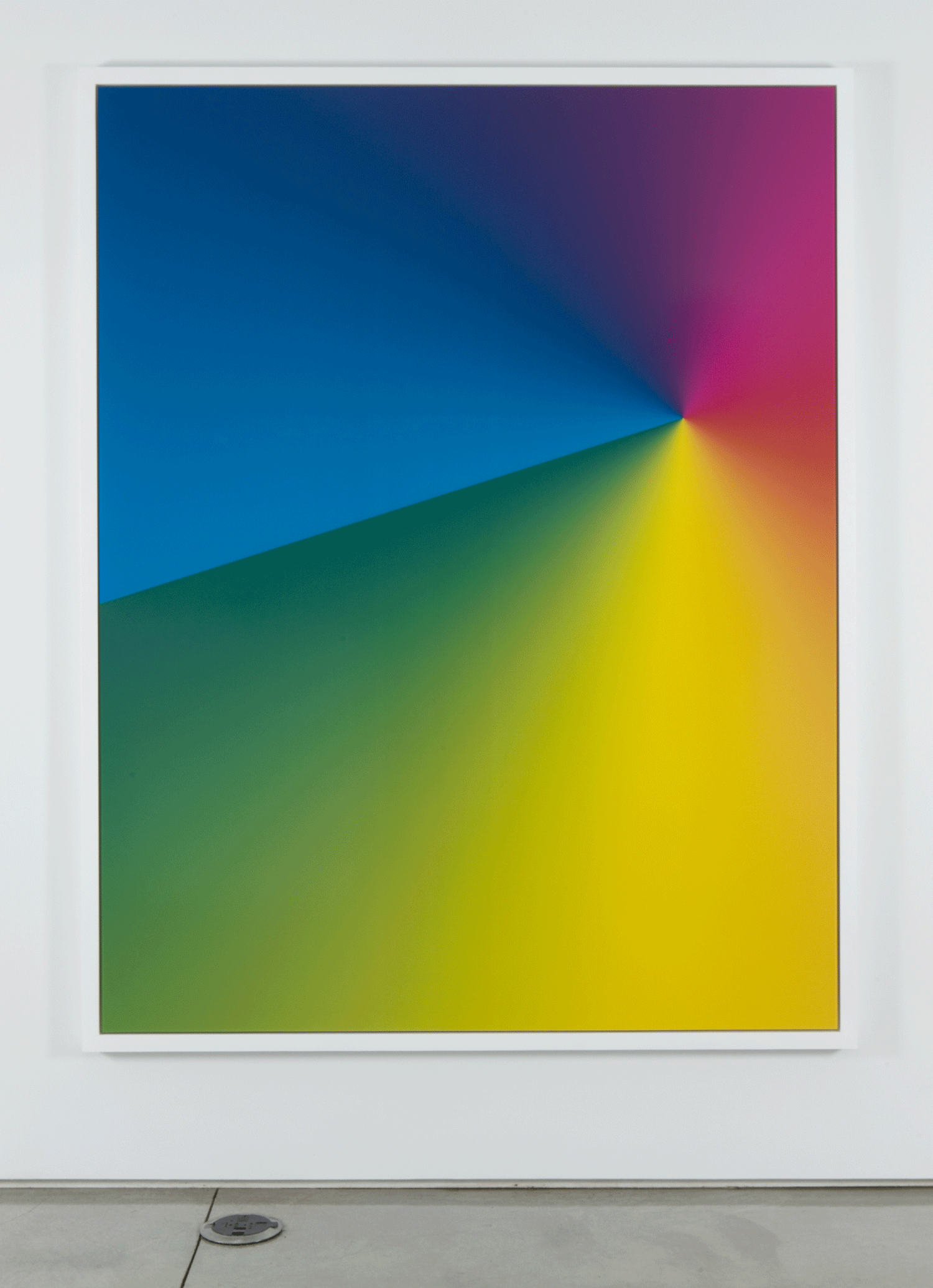
Arcangel often uses the artistic strategy of appropriation, creatively reusing existing materials such as dancing stands, Photoshop gradients and YouTube videos to create new works of art. His work explores the relationship between digital technology and pop culture. He is a recipient of a 2006 Creative Capital Emerging Fields Award. [1]

Notable Works:

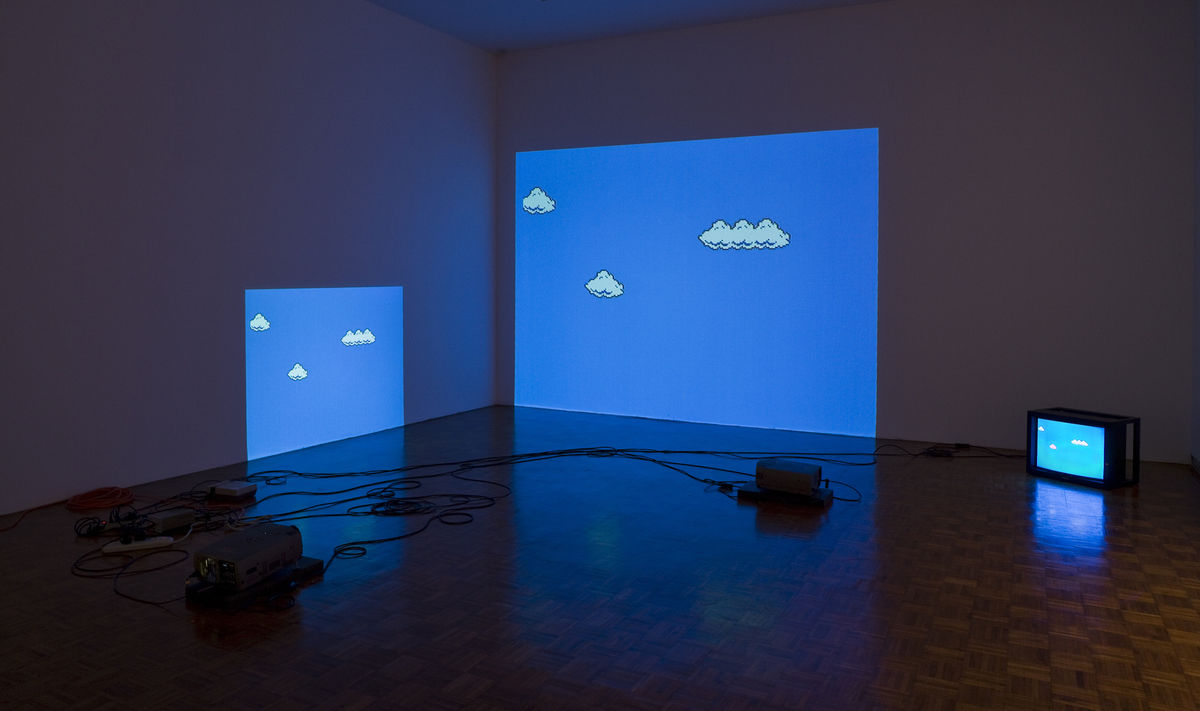
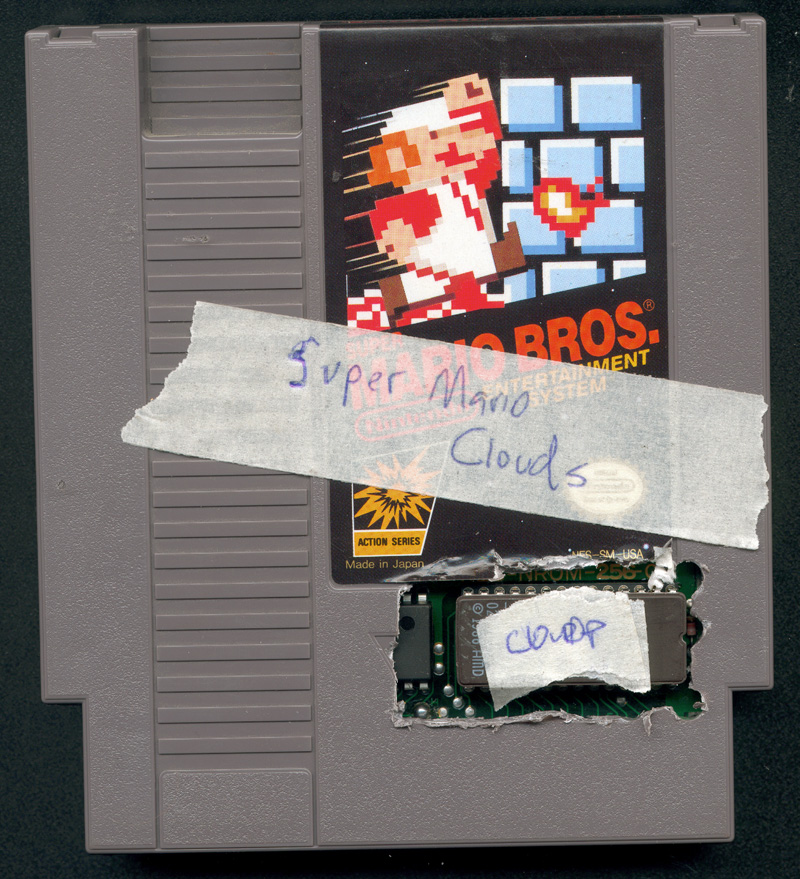
Super Mario Clouds Arcangel's best known works are his Nintendo game cartridge hacks and reworkings of obsolete computer systems of the 1970s and 80s. One example is Super Mario Clouds (2002), a modified version of the video game Super Mario Bros. for Nintendo's NES game console in which all of the game's graphics have been removed, leaving a blue background with white clouds scrolling slowly from right to left. [1]

Pizza Party Pizza Party (2004) was a free, functional software package that could be used to order Domino's Pizza through a command-line interface. The program allowed users to order pizza by typing in commands such as pizza_party -pmx 2 medium regular, which - according to the artist - would order two medium crust pizzas with pepperoni, mushrooms and extra cheese. The piece was commissioned by Eyebeam and implemented by Mike Frumin. [1]

Punk Rock 101 Punk Rock 101 (2006) is an example of Arcangel's work with the web as an artistic medium. For this piece, he re-published Kurt Cobain's alleged suicide letter alongside a series of Google Ads. The ads are tailored to the content of any given page, and the piece juxtaposed Cobain's angst with ads selling social anxiety treatment and motivational speaking. Art critic Paddy Johnson wrote of the work, "This is quite possibly the most brilliant subversion of the medium I have seen." [1]