foundyou.online - Directory for New Media Art
Open Filters
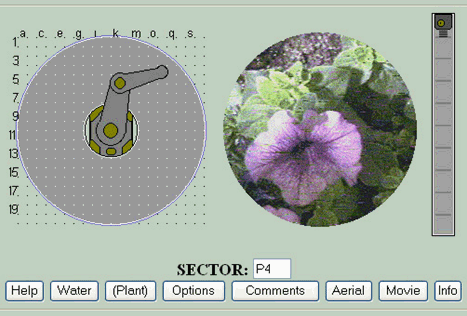
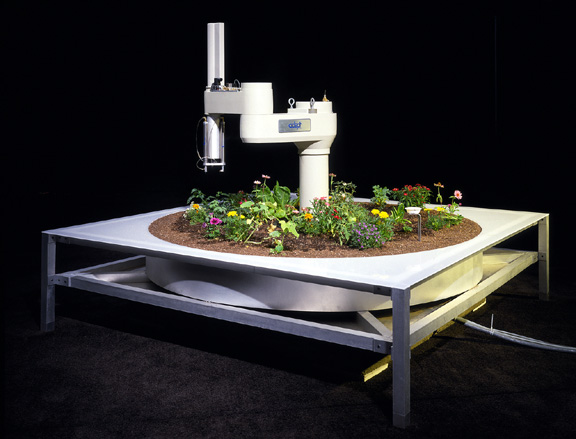
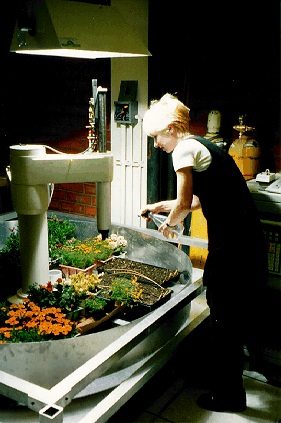
The TelegardenThe Telegarden (1995-2004), Ars Electronica Museum, Linz Austria.The TelegardenRosemary Morris at the gardenThe TelegardenTelegarden Interface
https://www.youtube.com/embed/vQE-qJ_aYPw
https://www.youtube.com/embed/gbyy5vSg8w8

The Telegarden is an art installation that allows web users to view and interact with a remote garden filled with living plants. Members can plant, water, and monitor the progress of seedlings via the tender movements of an industrial robot arm.[1]

Users participate in tending a living garden using a remote industrial robot to perform simple requests such as watering, planting and viewing the garden. Users are presented with a simple interface that displays the garden from a top view, the garden from a global composite view and a navigation and information view in the form of a robot schematic. By clicking on any of the images one commands the robot to move to a new absolute location or one relative to where they just were. The robot, upon completion of the move, will return a refreshed image of the garden. In this manner one can explore the entire garden remotely using simple mouse clicks. [2]

The robot performs users requests on a first come first server bases. Because of this multiplexing of the robot more than one user can be within the garden at once. By using the member tracker overlay one can not only see who but where other members are within the garden. If they wish to communicate with these other members they can enable or enter the village square. The village square is a public message chat system where people within the garden can discuss subjects of their choice. [2]

To water the garden users align the camera image over the section of the garden to water and press the water button. This will command the robot to release a small squirt of water over the area in view. To plant a seed a user is first requested to find a spot that is relatively empty (there are no restrictions to where one can plant) and then asked to press the plant button. This will cause the robot to poke a small hole in the ground, proceed to the seed bowl, suck up a seed and deposit it back into the previously dug hole.[2]

The Telegarden is a community project where users interact not only with the garden but amongst themselves. The project was created to push the possibility of web interaction using customizable user options, chat areas, garden movie making, web cameras, etc.[2]

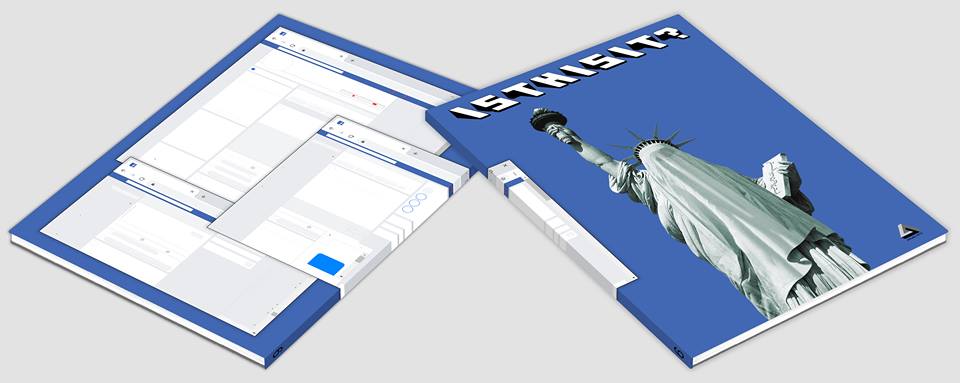
isthisit? is a platform for contemporary art, exhibiting over 700 artists since its creation in May 2016, founded by its current director, artist and curator Bob Bicknell-Knight. Online, it operates as a gallery producing monthly exhibitions showcasing emerging to mid-career artists, hosting a roster of guest curators experimenting with the medium of the internet to interrogate a variety of concepts. The website also hosts monthly residencies, where artists are given a web page to create new work that exists on the internet as a piece of net art. Offline, it has held exhibitions nationally and internationally and is the publisher of isthisit?, a book series released on a triannual basis.[1]

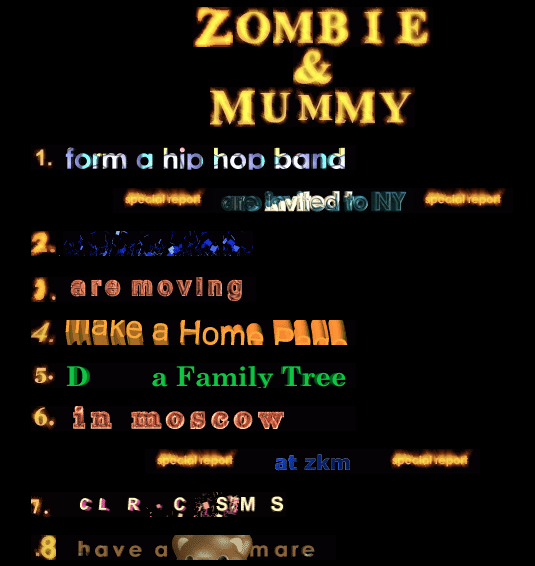
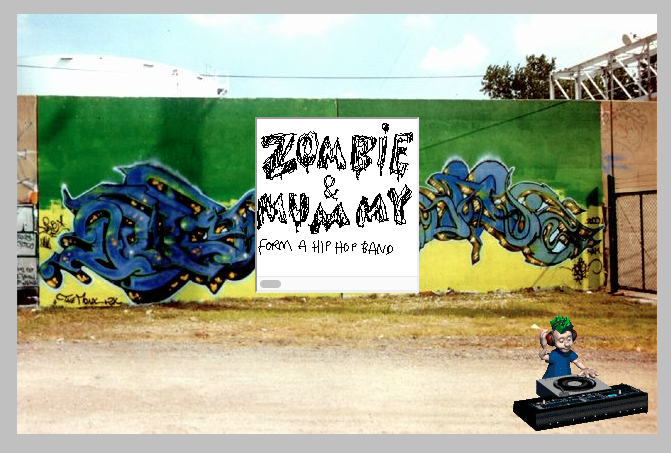
For Zombie & Mummy, Lialina and Espenschied are creating weekly episodes of a comic strip featuring the two title characters. Each episode is embedded in a colorful environment. Drawn on a Palm pilot, the cartoons themselves have a low-tech look, with no shades of gray and only 160x146 pixels per frame. They can be viewed online or downloaded for a palm device.[1]

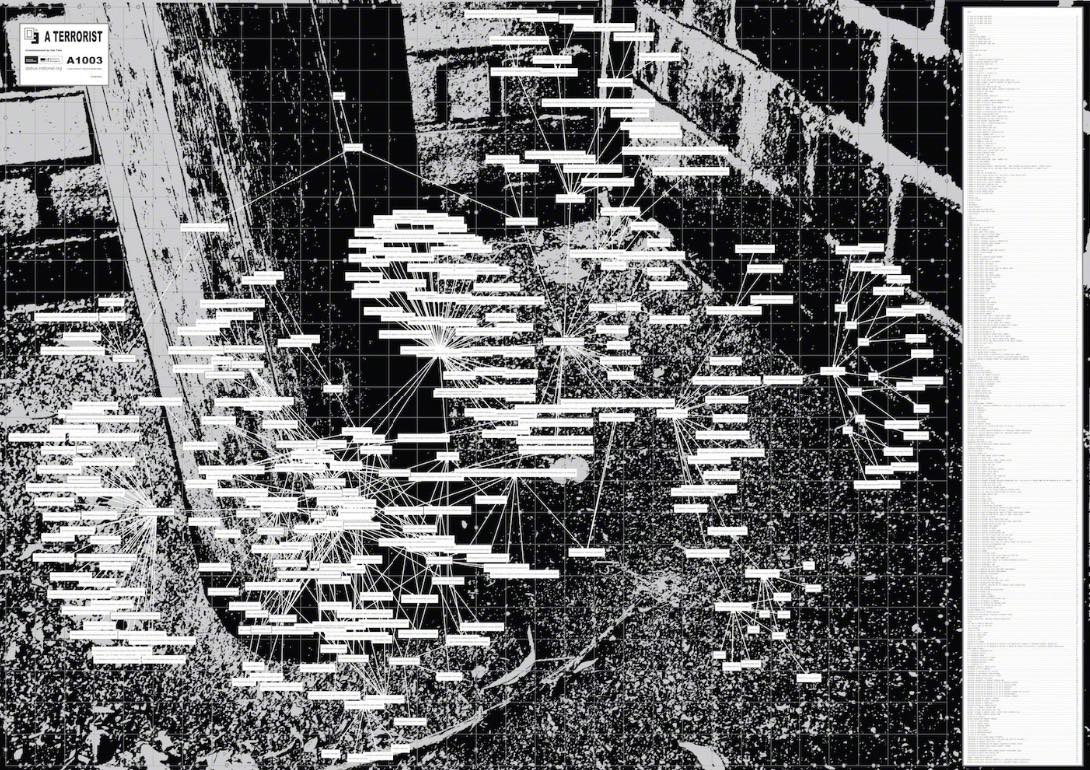
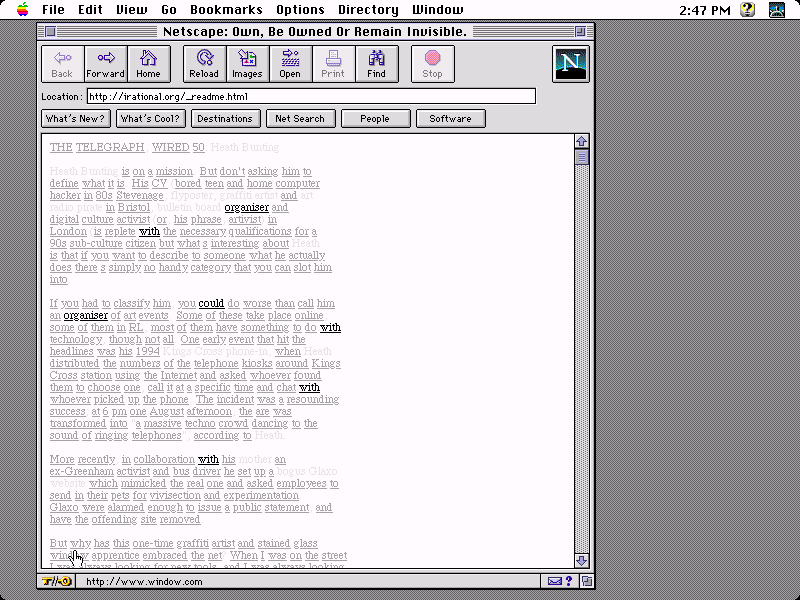
Heath Bunting is a British artist based in Bristol, UK. His work focuses on the development of open democratic and communication systems and social structures on the internet and in the public space. He has has worked in graffiti, performance, intervention, pirate radio, fax/ mail art, and BBS systems to become an active participant in the explosion of the internet.[1]

He is the founder of the site irational.org (with Daniel García Andújar, Rachel Baker and Minerva Cuevas) and was one of the early practitioners in the 1990s of Net.art. Bunting's work is based on creating open and democratic systems by modifying communications technologies and social systems. His work often explores the porosity of borders, both in physical space and online.[2]

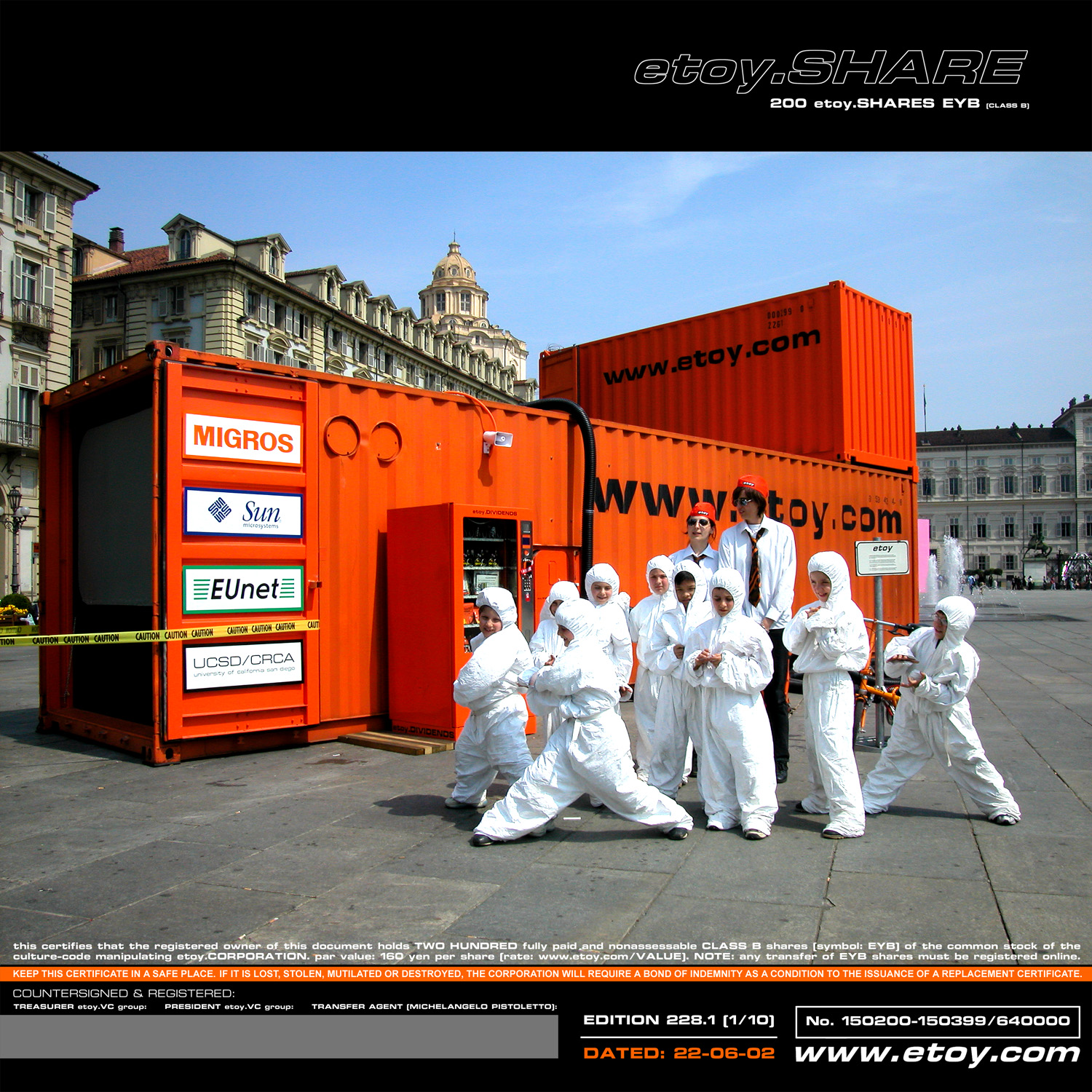
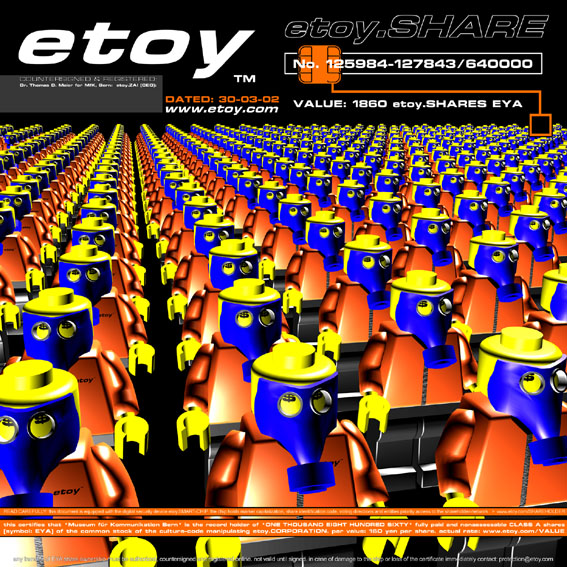
etoy.CORPORATION, an art group registered as a Swiss corporation, has been using internationally standardized (physical, virtual, legal and technical) containers to construct a global corporate sculpture since 1994. This "corporate sculpture" serves no purpose other than art - that is, the reflection of contemporary culture and its critical interaction with it.[1]

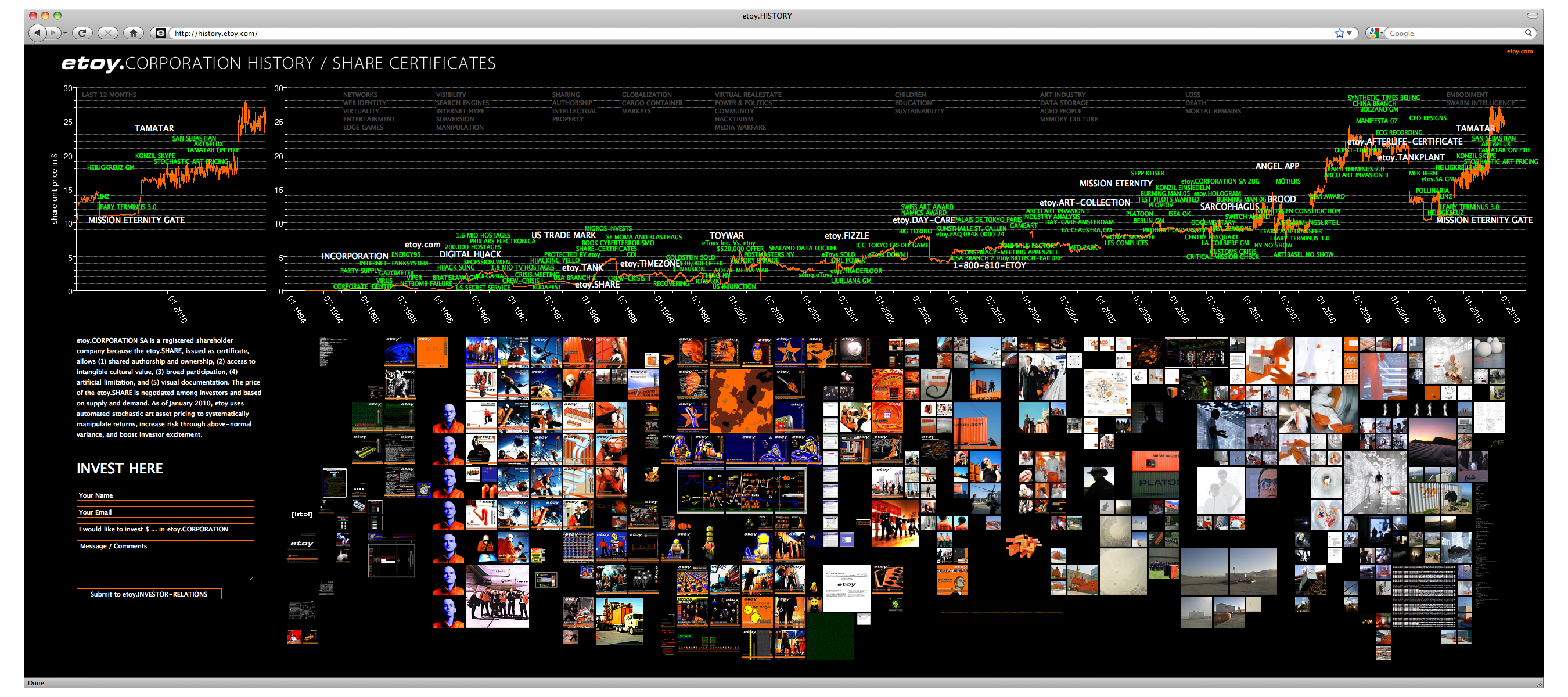
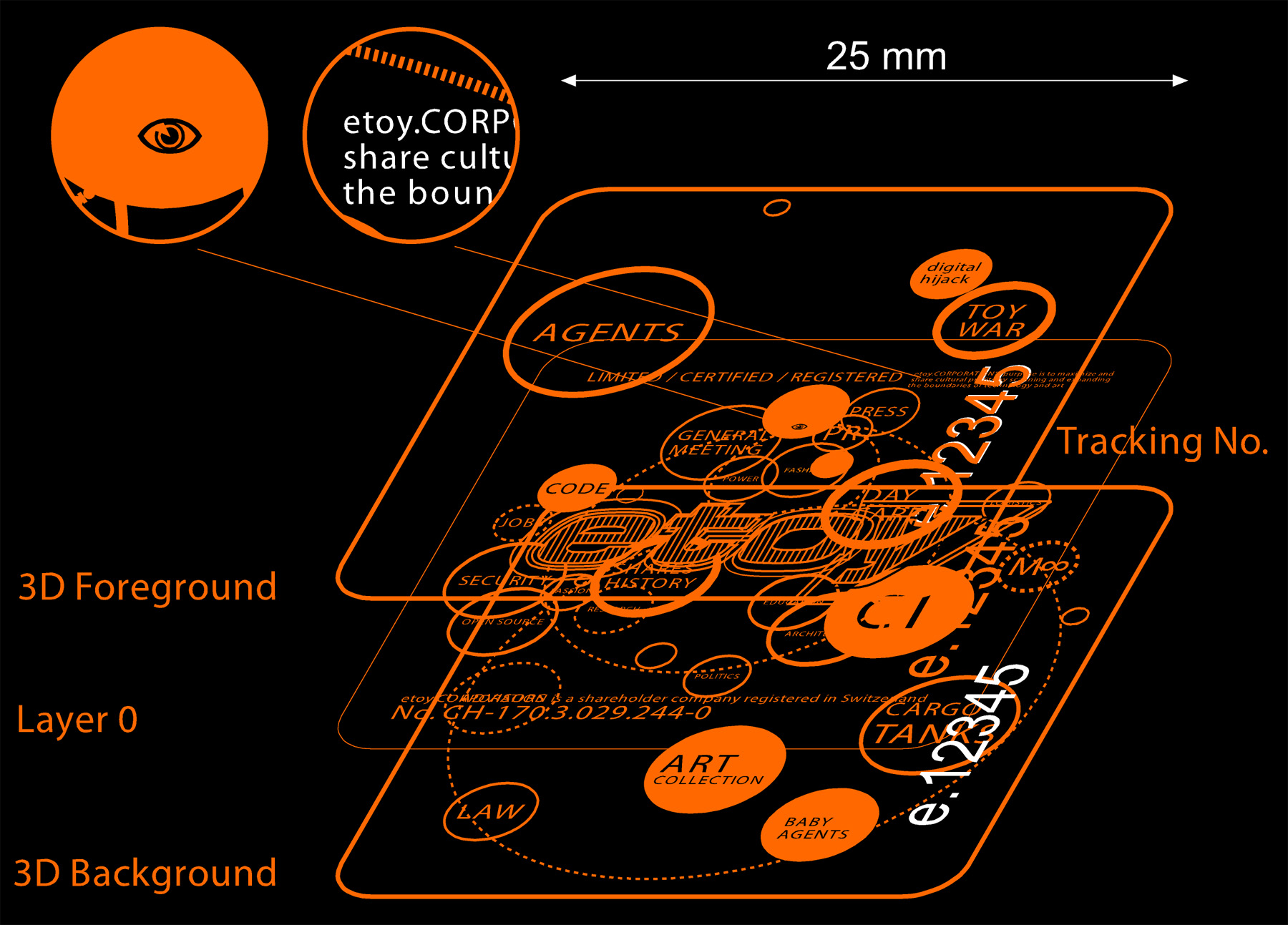
etoy.CORPORATION is art and invests all resources in the production of art beyond traditional dimensions. The aim is to take the resources, tools and legal framework of our time to create a corporate sculpture - a shareholder company registered in Zug/Switzerland that has no other purpose than cultural value. The privately held company etoy.CORPORATION SA issues etoy.SHARES (more information) to compensate its artists, investors, collectors and supporters. etoy.VENTURE association was founded 1994 and is registered in Zurich. This non-profit organization operates etoy.TANK-PLANTS in various cities, takes care of etoy.SOCIAL-ACTIVITIES, runs etoy.DAY-CARE and establishes MISSION ETERNITY - a digital cult of the dead. [2]

In the years 1999 to 2001, there was also a brand and domain name conflict with the American company eToys Inc., which became the largest online toy retailer during the boom years and reached a peak market value of around 10 billion US dollars. The fight for the rights to etoy.IDENTITY went down in history as a "TOYWAR" and is now part of textbooks. More than 400 international media have reported (from the New York Times and CNN, Art in America, to the Wall Street Journal). The group etoy has rejected very high financial offers of the counterparty precisely because the defense and preservation of the abstract identity container (TRADE MARK) in the case of etoy is much more important than the identity of the individual agents.[1]

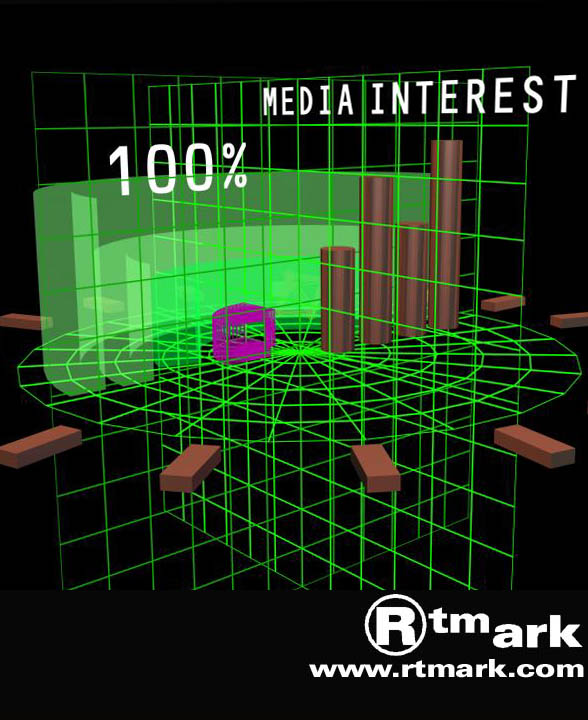
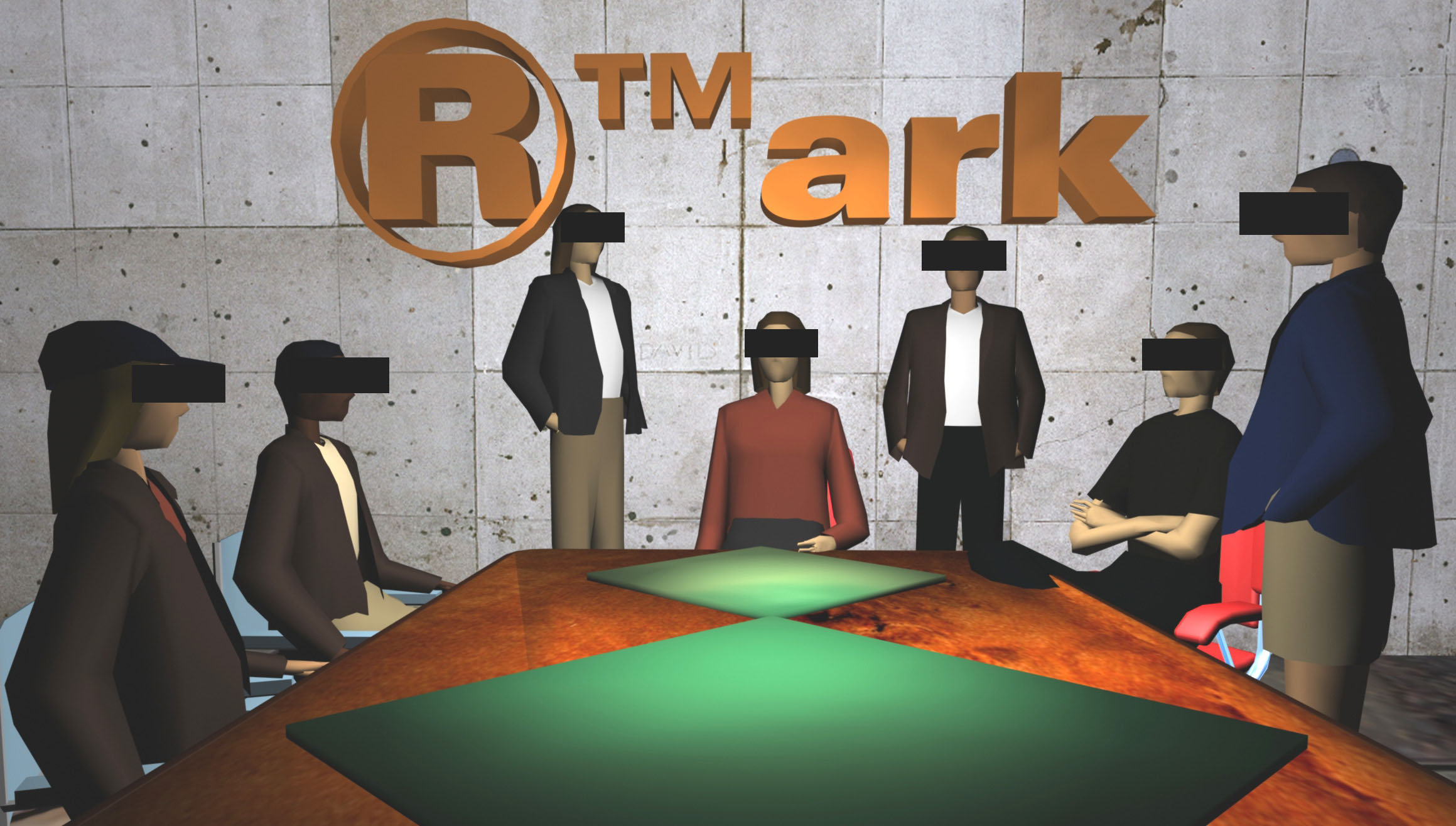
RTMark (derived from "Registered Trademark") is an activist collective that subverts the "Corporate Shield" protecting US corporations.

RTMark is itself a registered corporation which brings together activists who plan projects with donors who fund them. It thus operates outside the laws governing human individuals, and benefits from the much looser laws governing corporation. [1]

What does ®TMark do?

®TMark receives project ideas from internet users, then lists them (here). Each listed project has its own discussion list (linked from the project). When a project requires a bit of funding to be accomplished, sometimes investors will step up to the plate and offer their help. Even more often, people will offer non-financial help or feedback.

How is ®TMark defined, in legal terms?

®TMark is a brokerage that benefits from «limited liability» just like any other corporation; using this principle, ®TMark supports the sabotage (informative alteration) of corporate products, from dolls and children's learning tools to electronic action games, by channelling funds from investors to workers for specific projects grouped into "mutual funds."

So ®TMark is just a corporation?

®TMark is indeed just a corporation, and benefits from corporate protections, but unlike other corporations, its ‹bottom line› is to improve culture, rather than its own pocketbook; it seeks cultural profit, not financial. [2]

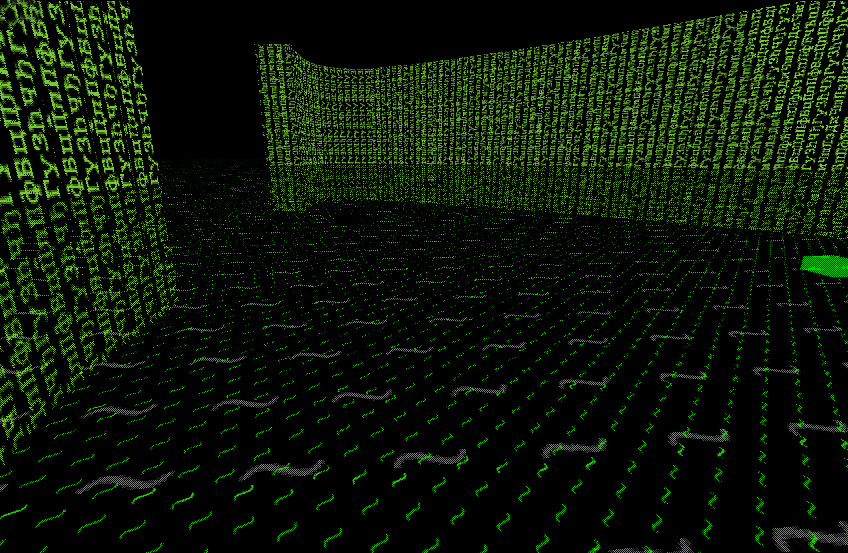
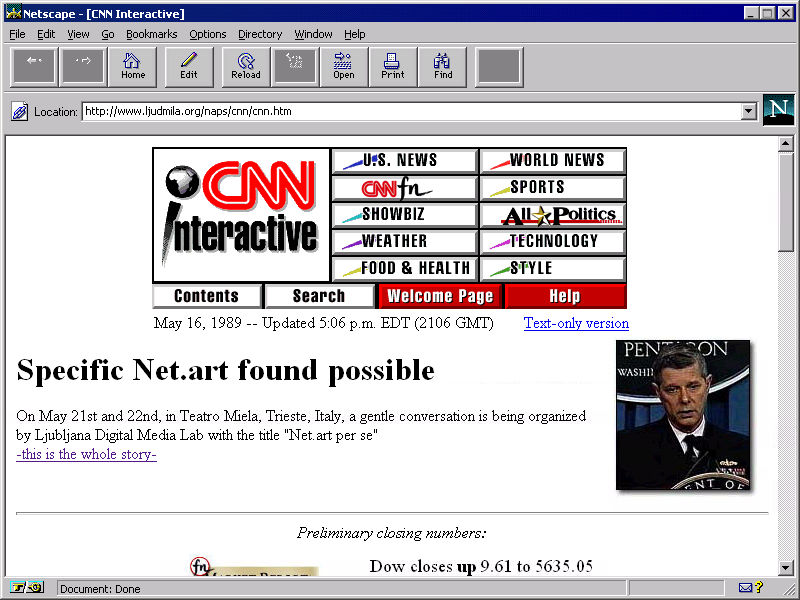
Vuk Ćosić (born July 31, 1966 in Belgrade) is a Slovenian contemporary artist associated with the net.art movement. Active in politics, literature and art, Ćosić has exhibited, published, and been active since 1994. He is well known for his challenging, ground-breaking work as a pioneer in the field of net.art. His constantly evolving oeuvre is characterized by an interesting mix of philosophical, political, and conceptual network-related issues on the one hand, and an innovative feeling for contemporary urban and underground aesthetics on the other. One of the pioneers of net.art, Ćosić became deeply interested in ASCII code during a long period of research (1996–2001) on low-tech aesthetics, the economy, ecology and archaeology of the media, on the intersections between text and computer code, on the use of spaces in information, its fluid nature and infinite convertibility. Out of this came History of Art for the Blind, ASCII Unreal (an art game), ASCII Camera, ASCII Architecture, Deep ASCII and ASCII History of Moving Images, a history of the cinema converted into text format. He is a co-founder of Nettime, Syndicate, 7-11, and Ljubljana Digital Media Lab. [1]

After the golden days of net.art, he decided to become an ASCII artist. Why ASCII? For several reasons: because it existed before computing; not everyone takes it seriously, it's rather ugly (won't be recuperated by the art world very easily) and it's sexy (infected by hacker virus).[2]

Vuk Cosic was the Slovenian representative to the Venice Biennale in 2001, he’s the co-founder of Ljudmila — a digital media lab for artists in Slovenia and of the ASCII Art Ensemble and of course he’s a pioneer in the field of net.art. He gained the notoriety for having copied the DocumentaX website in 1997. After the art event closed, the website was set to shut down. And it did closed, but not before Cosic copied it. And it’s still up.[3]

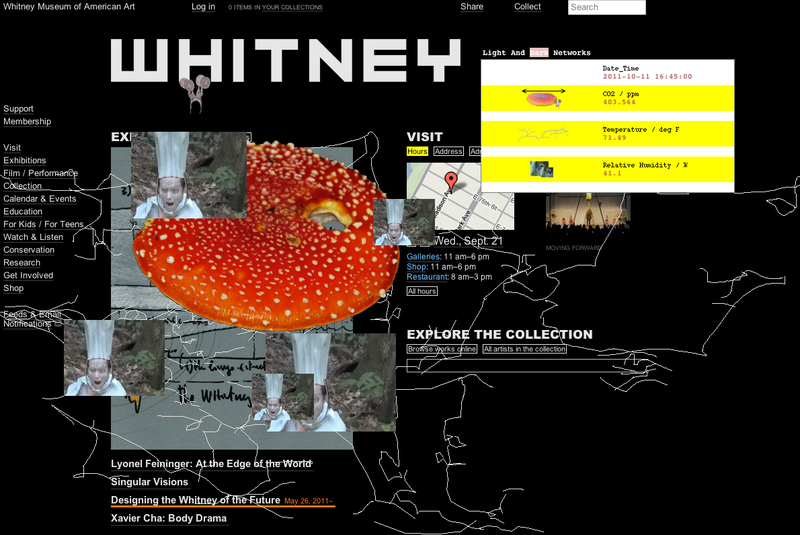
Whitney ArtportWhitney ArtportUrsula Endlicher, Light and Dark Networks, 2011.
https://www.youtube-nocookie.com/embed/e1ehF1tOoaA

Artport is the Whitney Museum's portal to Internet art and an online gallery space for commissions of net art and new media art. Originally launched in 2001, Artport provides access to original art works commissioned specifically for Artport by the Whitney, documentation of net art and new media art exhibitions at the Whitney, and new media art in the Museum's collection. [1]

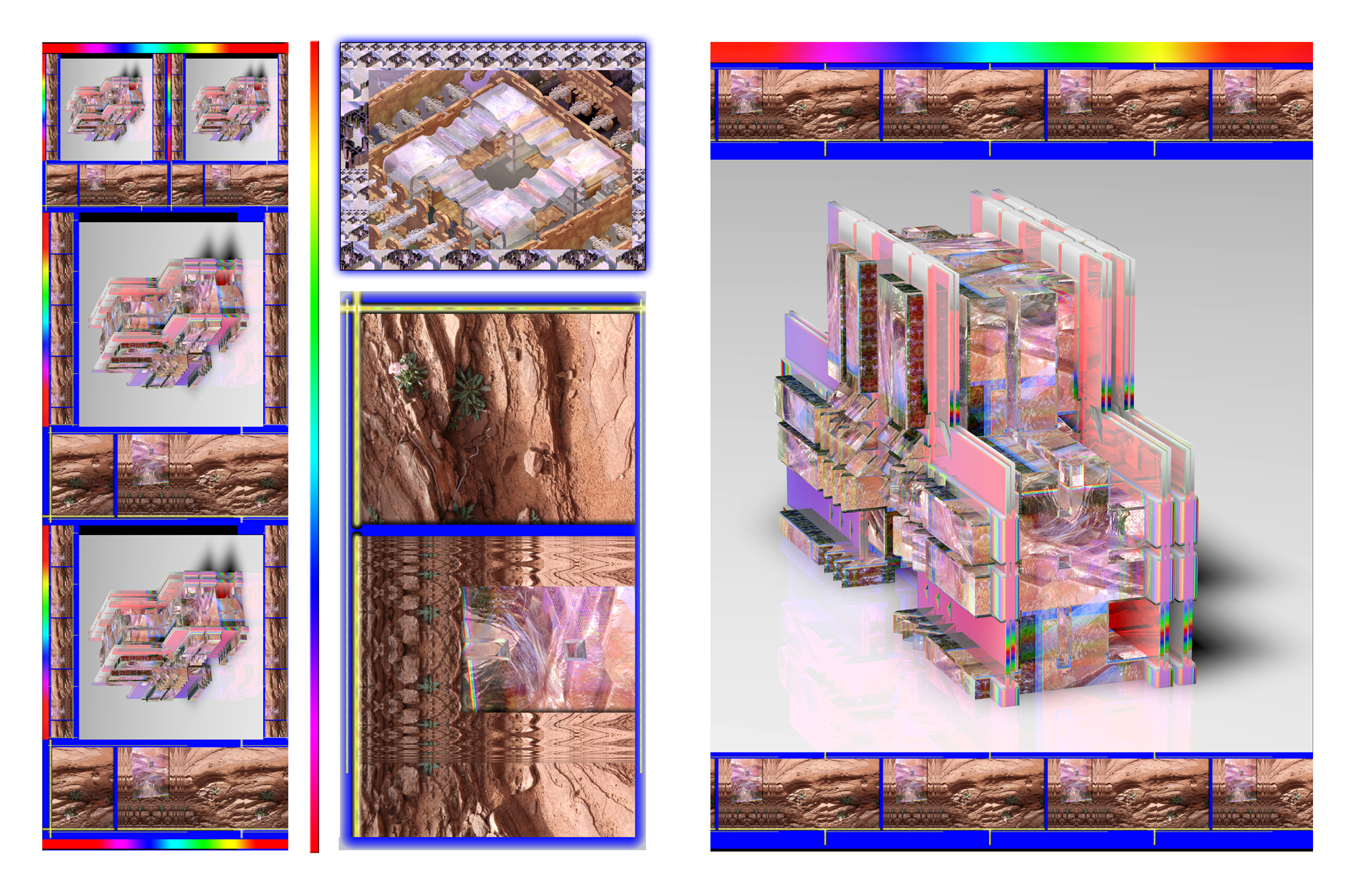
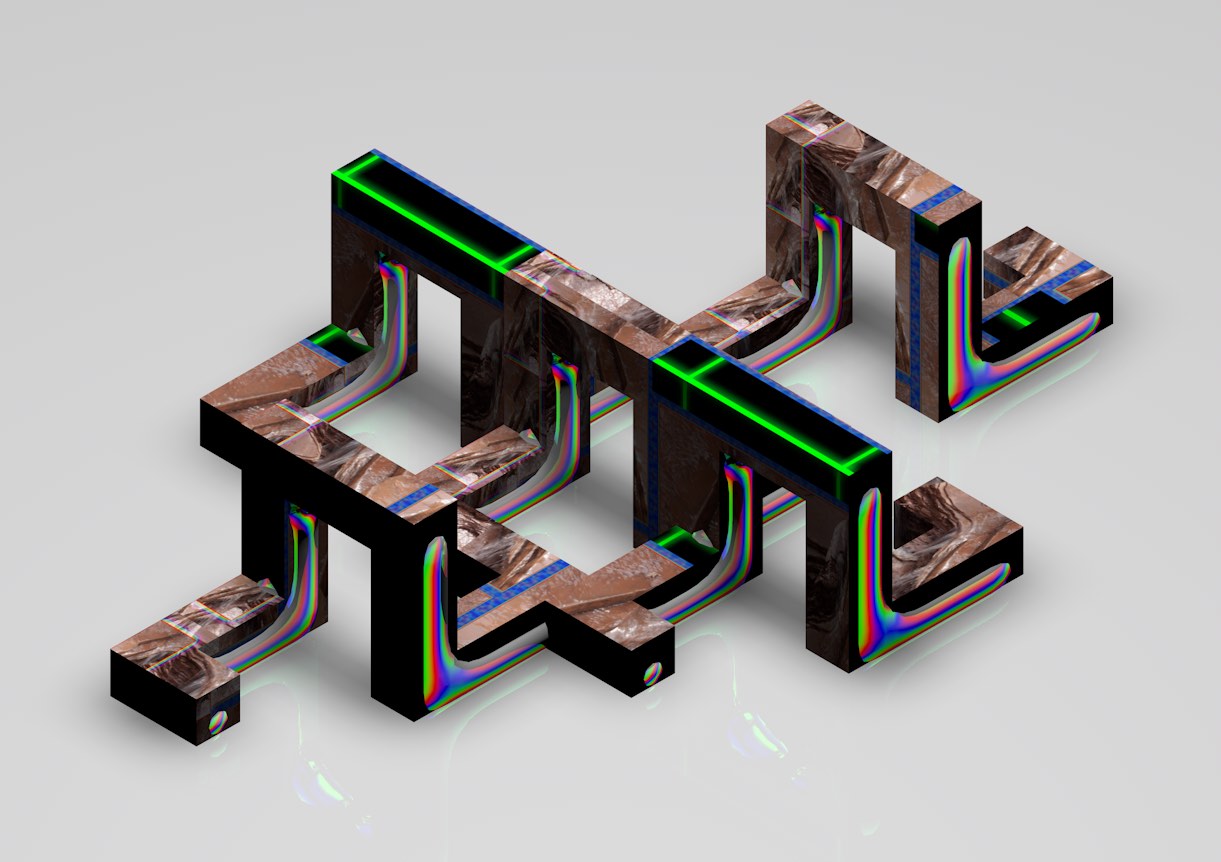
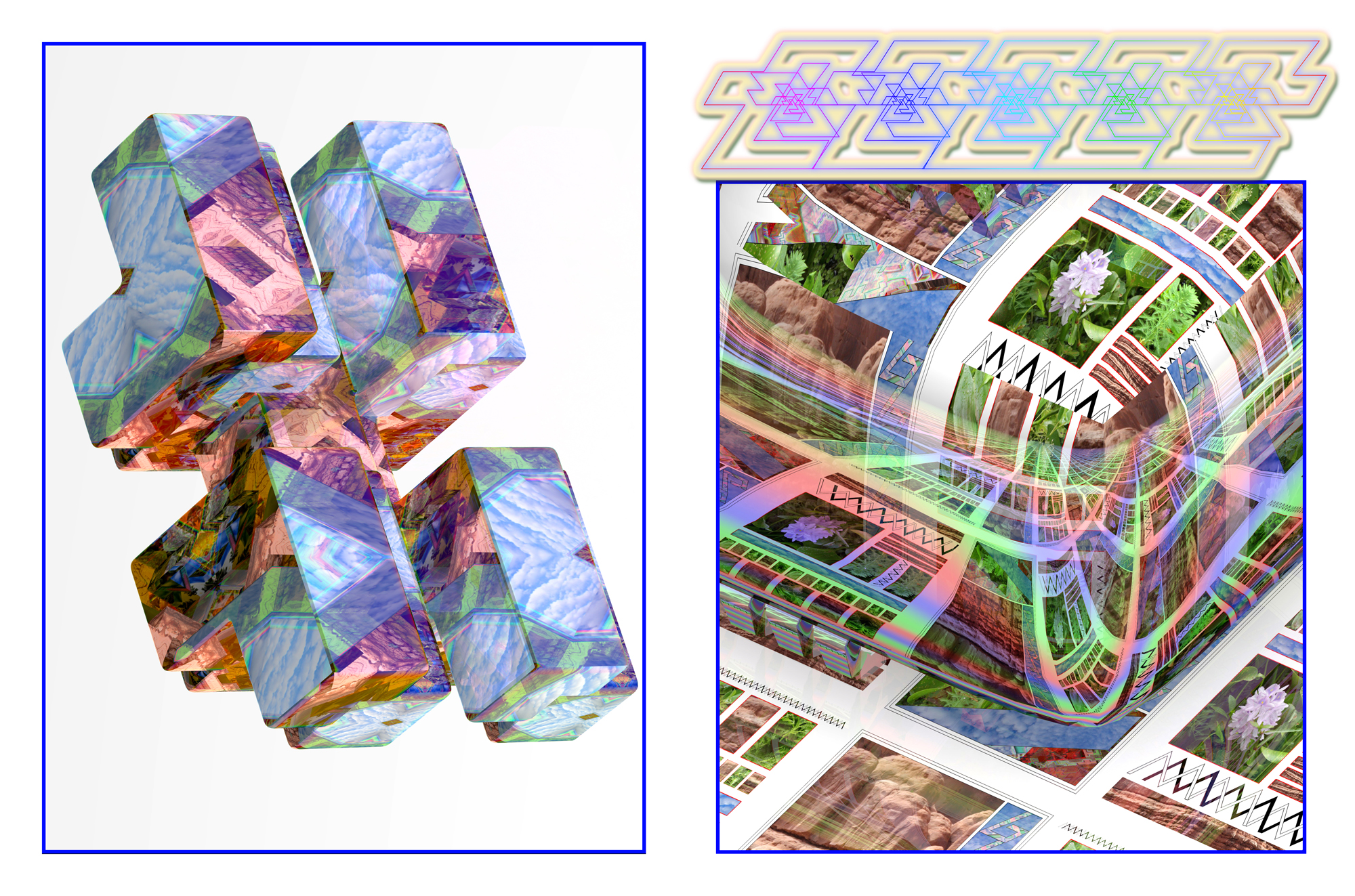
Brenna Murphy (born 1986) is an American artist based in Portland, Oregon. Her works combine digital and physical input, combining psychedelic visual forms with three-dimensional objects. Murphy's work has been called strange, but with an "uncanny familiarity." Murphy thinks of herself as a channel that mediates between the digital and the physical. She privileges neither the physical nor the virtual and her sculptures are models of her net-based works as much as her net-based works are models of her sculptures. [1]

Her exhibition Liquid Vehicle Transmitters appeared at the Yerba Buena Center for the Arts in San Francisco, CA in 2013. The exhibit featured prints and physical representations of her internet-based work, forming "an interactive arena of labyrinthine sculptures". An auxiliary installation featured the audiovisual work of MSHR, her collaboration with Birch Cooper. Her work has been exhibited online via the New Museum and in group shows including This is what sculpture looks like, at the Postmasters Gallery in New York City. Her work has been collected in the book Domain~Lattice. [1]

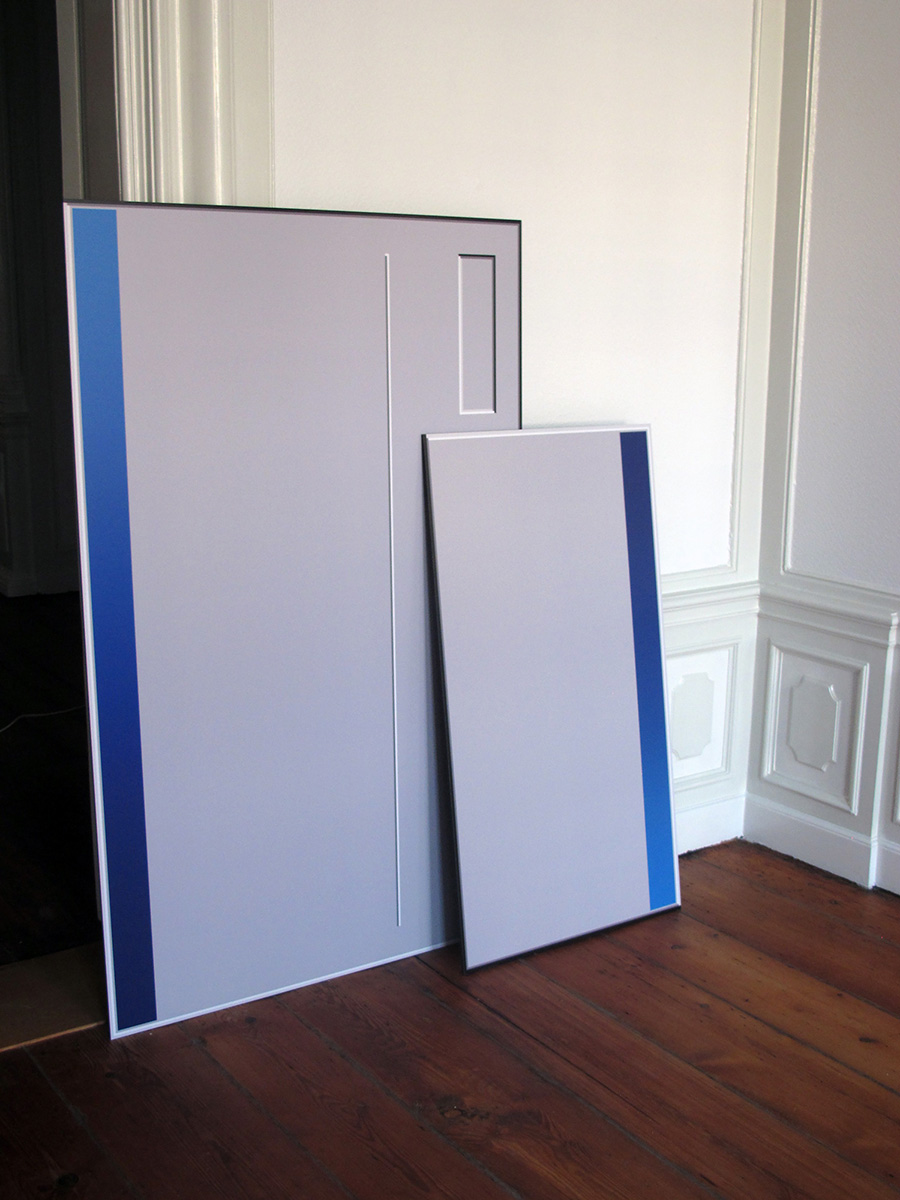
Jan Robert Leegte is among the first artists who were involved in the 90s NetArt movement. Since 1997, he creates art in the form of websites, which he connects to art historical movements such as minimalism, land art and conceptualism. Leegte also translates the themes of his work to offline media such as print, sculpture and projections. A reoccurring theme in his work is the sculptural materiality of interfaces of computer programs. Like the early graphic design of cursors, selection boxes and menu bars that were to give the user the impression of actually physically pressing the buttons with graphic shadows. Leegte often uses these components and by placing them in a new context, giving them their own, sculptural legitimacy. [1]